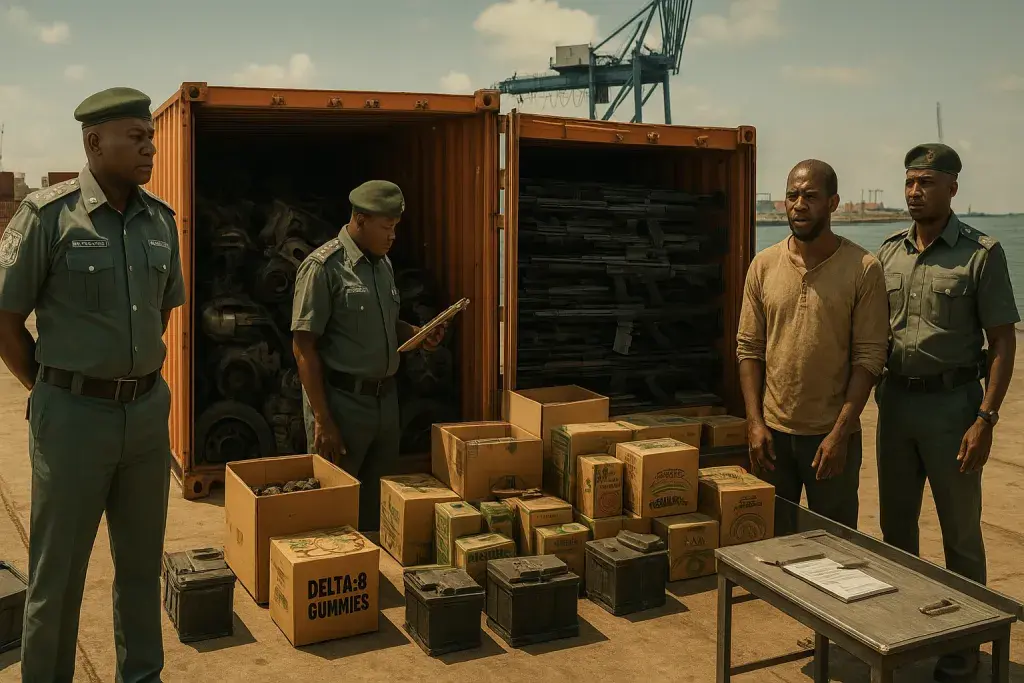
A single flagged container at Tincan Island Port has surfaced two distinct enforcement stories at once: an arms-smuggling attempt built around knocked-down firearm components, and a cannabis-infused product seizure valued at more than ₦373.8 million. The Comptroller General of Customs, Adewale Adeniyi, announced both interceptions on Thursday, 6 August 2026, tying them to the Service's intelligence-driven risk management system that flags high-risk shipments before they clear the port.
The firearms case involved a container that arrived aboard MV VELIKA on 8 July 2026, with crates concealing components preliminarily identified as parts for more than 140 JoJeff pump-action rifles. Two suspects have been arrested; a third remains at large. That timeline matters for anyone tracking how illicit cargo moves through legitimate trade lanes - weeks can pass between arrival and interdiction, which is precisely the window smuggling networks count on. For licensed cannabis operators watching global enforcement trends, the parallel case is the more instructive one: two 40-foot containers carrying Delta-8 cannabis-infused pre-roll cookies, gummies and cookies, hidden alongside used vehicles, generators and batteries, a concealment pattern that mirrors how legitimate operators elsewhere rely on cannabis POS and inventory software to keep every SKU traceable from manifest to shelf, precisely the kind of transparency absent in these seized shipments.
Why Cannabis-Infused Products Keep Turning Up in Contraband Cargo
Nigeria has no regulated adult-use or medical cannabis retail channel, so any cannabis-infused product entering the country arrives outside a compliant framework, no COA, no batch testing, no age-verified point of sale. That absence of a legal supply chain is exactly why these goods get bundled with used vehicles, generators and batteries: smugglers count on customs officers focusing on the obvious contraband while infused edibles ride along in the same load. The seized items, described as Delta-8 pre-roll cookies, gummies and cannabis-infused cookies, represent a product category that in regulated markets would be subject to compliant packaging, potency labeling and seed-to-sale tracking. Here, none of that exists, and the street-value figure cited by Customs reflects an unregulated black market, not a licensed wholesale menu.
The Election-Season Angle and What It Signals for Enforcement
Adeniyi's warning about the coming election cycle is not incidental. Ports and land borders tend to see heavier smuggling pressure around major political transitions, when security attention is stretched and criminal networks bet on distraction. His comment that the Service "will not harbour any of these people who want to serve as accomplices" is a pointed acknowledgment that internal compromise, not just external smuggling ingenuity, remains a live risk inside customs operations.
Operational Lessons for Legitimate Supply Chains
For businesses operating in jurisdictions where cannabis commerce is licensed, this case is a reminder of what separates compliant trade from contraband. Risk-profiling systems, manifest verification and inter-agency intelligence sharing are the same mechanisms regulated cannabis markets depend on to prevent diversion and inventory shrinkage. Where those controls exist, product movement is documented at every step; where they don't, containers like the ones intercepted at Tincan Island become vehicles for both weapons and unregulated narcotics alike.