Daylin Leach once knew every operator running a dispensary in Pennsylvania. He helped write the law that made those businesses legal. Today, he says, he doesn't recognize a single name on the state's retail roster - and that shift tells you almost everything about where the medical cannabis industry has landed a decade after legalization.
How Capital Requirements Reshaped Ownership
The mechanism here isn't mysterious. Growing and dispensing cannabis requires serious upfront capital - build-out costs, compliant packaging systems, seed-to-sale tracking infrastructure, security, lab testing contracts - and traditional banks largely won't touch the industry because cannabis remains federally illegal. That leaves operators chasing private credit, nontraditional lenders, or outright acquisition offers. Multistate corporations, often publicly traded, can tap shareholder capital or internal cash flow to cover losses and still expand. A single-location operator in Uniontown or New Stanton doesn't have that luxury. When margins tighten, the local shop sells; the public company buys.
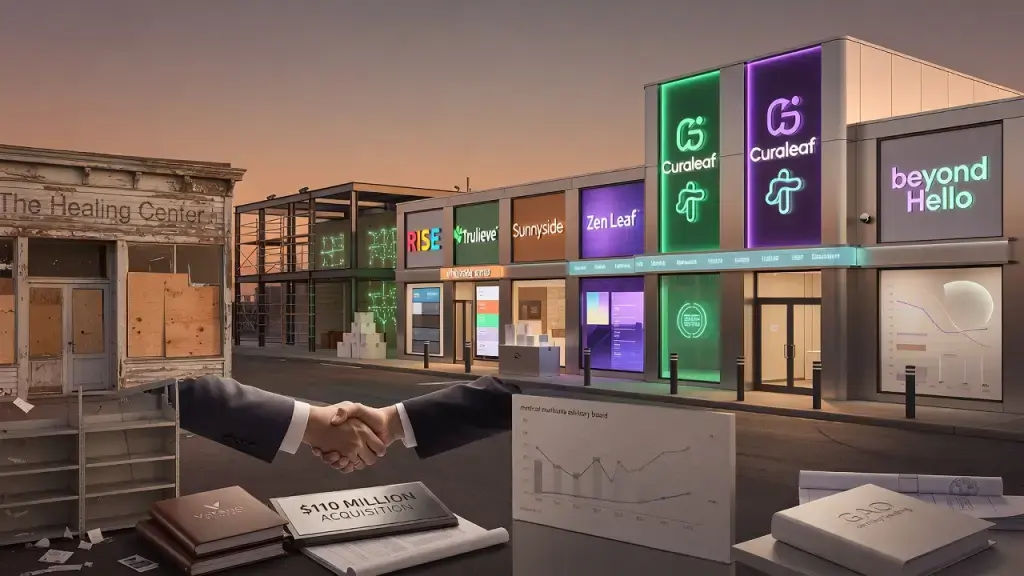
That dynamic played out across southwestern Pennsylvania starting around 2018, as mergers and acquisitions swept up permits that had originally gone to regional owners. Chris Kohan, who built The Healing Center into a locally run chain before selling to Verano Holdings for a reported $110 million, put it plainly: he didn't feel he had much choice if he wanted to stay competitive. Operators who held onto their permits instead of selling, he said, are often the ones wishing they hadn't.
What Consolidation Changes on the Ground
Ownership consolidation isn't just a balance-sheet story - it changes what a dispensary looks like day to day. Kohan described losing on-site pharmacists in favor of virtual consultations after the Verano acquisition, along with staff cuts and the slow erosion of what had been a distinct, locally branded operation. Verano disputes part of that account, saying it employs nearly 20 pharmacists statewide offering both in-person and virtual consultations, and that it maintains philanthropic commitments including expungement clinic support.
Either way, the broader pattern is hard to miss: six multistate retail brands - Curaleaf, RISE, Trulieve, Zen Leaf, Sunnyside and Beyond Hello - now operate more than half of Pennsylvania's dispensaries. Every one of their parent companies trades publicly. That access to public markets is precisely what lets them absorb price pressure that would sink a smaller, privately held operator.
Oversupply, Falling Prices, and the Squeeze on Small Operators
Falling wholesale and retail prices compound the problem. The retail price of dry leaf in Pennsylvania dropped sharply between early 2021 and mid-2025, according to a presentation to the Department of Health's Medical Marijuana Advisory Board - a pattern researchers like UC Berkeley's Michael Polson have observed in other legal markets, including California, where early-stage investment rushes often lead to oversupply and depressed pricing. Large operators can offset thin margins in one state with revenue from another, or lean on vertical integration to control costs from cultivation through retail. Independent operators typically can't.
Lending arrangements add another layer of risk. A federal Government Accountability Office report found that some cannabis companies have entered contracts with private investors structured in ways that could allow those investors to eventually take control of the business - a dynamic reflected in Pennsylvania filings involving companies like Maitri Medicinals, which defaulted on debt and lease obligations tied to a private credit lender.
The Legislative Response and Its Limits
Pennsylvania lawmakers tried to counterbalance this trend with Act 63 of 2023, which let companies holding only a grower-processor or only a dispensary permit apply for the other type - intended to help independent operators compete on more equal footing. Roughly a dozen companies have since received permits through that pathway, according to the Department of Health. It's a meaningful policy tool, but it hasn't reversed the broader trajectory. Multistate operators still dominate shelf space, wholesale menus, and brand visibility across the state. As Leach put it, driving around Pennsylvania now means passing a Curaleaf every couple of blocks - a simple observation that captures a complicated structural shift in who actually controls access to medical cannabis in the state.