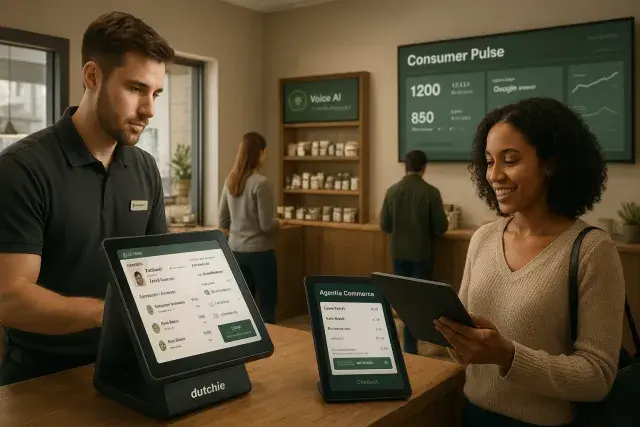
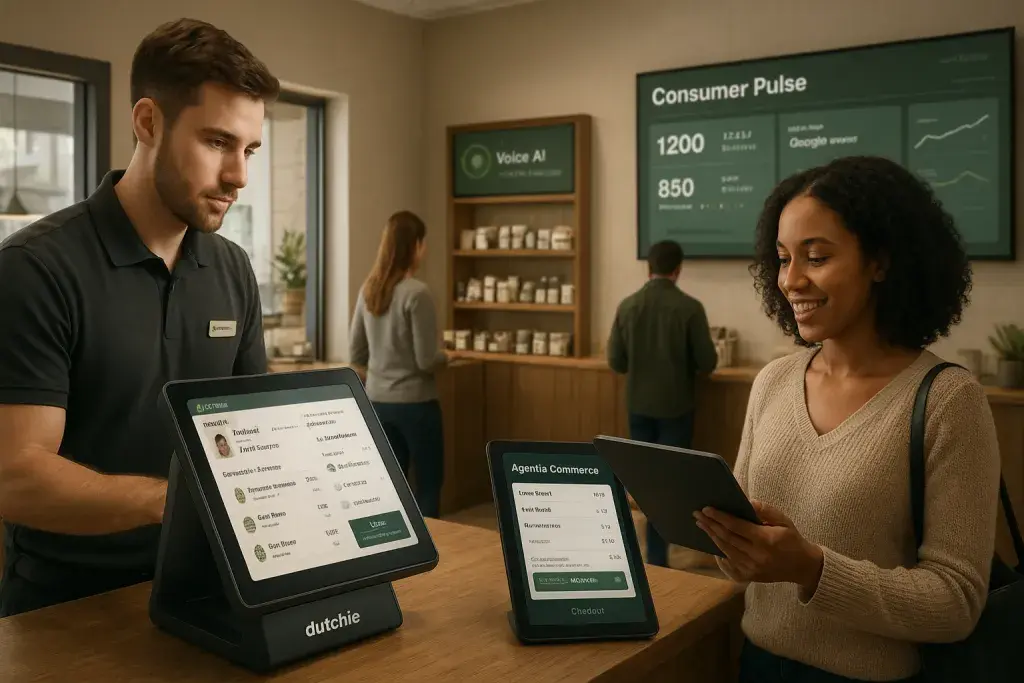
Dutchie has introduced a suite of four AI-powered products built directly into its existing point-of-sale and e-commerce platforms, aiming to give cannabis retailers automated tools for customer interaction, checkout optimization, and reputation management - without requiring operators to adopt separate third-party software. The launch, branded as Dutchie Consumer AI, comes as cannabis retailers face mounting pressure to improve margins, retain customers, and run leaner operations in an increasingly competitive adult-use market. For operators ranging from single-location independents to multi-state groups, the timing reflects a broader shift: AI tools are no longer a future consideration. They are arriving at the POS terminal now.
Four Products, One Customer Identity
What distinguishes Dutchie's approach - at least on paper - is the decision to unify all four tools under a single customer identity layer. That means a consumer who calls ahead, places an order online, walks into the budroom, and later leaves a Google review is recognized as the same individual across every touchpoint. For operators managing customer data across fragmented systems, that kind of continuity has real operational value. Retailers in markets with robust compliance requirements, such as those relying on dispensary software in Montana or similar state-specific platforms, already understand the cost of disconnected data - inventory discrepancies, broken loyalty flows, and compliance reporting headaches that compound quickly at scale. The promise of a unified identity threading through voice, e-commerce, in-store, and review channels is worth watching, though integration depth will ultimately determine whether that promise holds in daily operations.
The four products break down as follows. Voice AI functions as an automated phone receptionist - answering inbound calls, fielding questions about hours and inventory, helping customers place or confirm orders, and routing to a human staff member when needed. For high-volume dispensaries where unanswered calls translate directly to lost sales, that's a concrete operational fix. Agentic Commerce goes further: rather than surfacing product suggestions the way a basic chatbot might, it is designed to build the cart, handle substitutions when items are out of stock, and take the customer through to checkout. A returning customer can reportedly rebuild a previous order in a single tap. Register Co-Pilot sits inside the Dutchie POS terminal itself, giving budtenders real-time access to a customer's purchase history, suggested pairings, upsell prompts, and loyalty status at the moment of checkout. And Consumer Pulse aggregates first-party survey data from digital orders and receipts alongside public review platforms, surfacing sentiment trends and alerts designed to help operators respond to customer feedback before it becomes a ratings problem.
Why This Matters for Dispensary Economics
Cannabis retail is an unusually margin-compressed business. Operators in adult-use states carry the weight of excise taxes, state and local licensing fees, 280E federal tax treatment that disallows standard business deductions, and compliance infrastructure costs that most general retailers never encounter. Against that backdrop, basket size is one of the levers operators can actually pull. If a tool like Register Co-Pilot nudges budtenders toward a pairing recommendation that converts - or if Agentic Commerce reduces cart abandonment online - the revenue impact compounds across thousands of transactions. That's not abstract. It's the difference between a store running a 12% net margin and one running at 8%.
The thing is, budtender consistency has always been one of the hardest problems in cannabis retail to systematize. Staff turnover in the industry runs high, and the gap between a veteran budtender and a new hire's ability to upsell, recommend accurately, and move a customer through checkout efficiently is significant. Co-Pilot is essentially an attempt to codify the institutional knowledge of a store's best performer and deliver it to every register, in real time. Whether that holds up across high-traffic weekend rushes and complex medical customer interactions remains to be seen - but the design intent is sound.
The Regulatory and Competitive Context
Dutchie's Consumer AI launch arrives as federal cannabis rescheduling discussions continue to shape operator sentiment around long-term investment. Rescheduling, if it proceeds, could alter the 280E tax burden that has constrained dispensary profitability for years - which would change the calculus around how aggressively operators invest in technology. Multi-state operators already under pressure from intensifying competition in mature adult-use markets are particularly attentive to tools that promise efficiency gains without requiring a platform overhaul. The fact that Dutchie is embedding these capabilities into existing POS and e-commerce workflows - rather than selling a separate AI subscription that requires migration - reduces the adoption friction considerably.
Consumer Pulse, the reputation management component, addresses something operators often handle manually and reactively: tracking public reviews, identifying complaint patterns, and coordinating responses. In a regulated industry where a dispensary's public reputation is subject to state advertising rules that restrict what retailers can say and where they can say it, managing the review channel is one of the few relatively unrestricted avenues for brand building. Centralizing that alongside first-party survey data gives operators a more complete picture of customer sentiment than either source provides on its own. That's a practical gain for store managers who currently split their attention across multiple platforms to monitor feedback. The broader market question - whether AI-assisted cannabis retail tools actually move retention and revenue metrics at the store level - will take time and real-world operator data to answer. But Dutchie's direction is clear: the company is betting that cannabis retailers want AI where they already work, not as an additional tab to open.