Fresh Venture Farms in Ontario, Canada, has raised bell pepper production by an average of 16% over four years through targeted improvements in irrigation water quality. Growers there credit cavitating ultrasonic transmitters, nanobubble technology, and reduced hydrogen peroxide use for healthier roots and higher yields. The approach has slashed costs and enabled full water recycling, pointing to practical paths for sustainable greenhouse farming.
Cleaning Water Without Chemicals
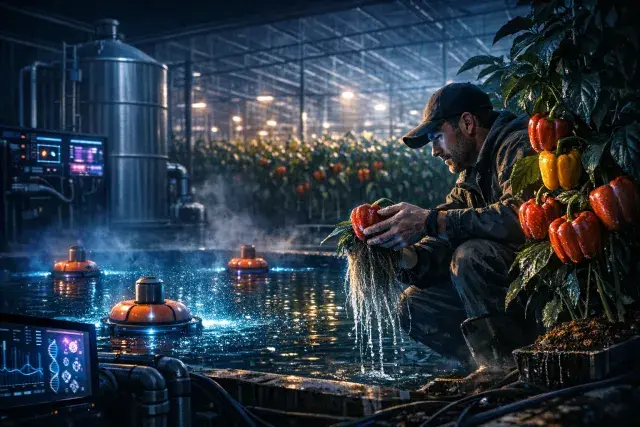
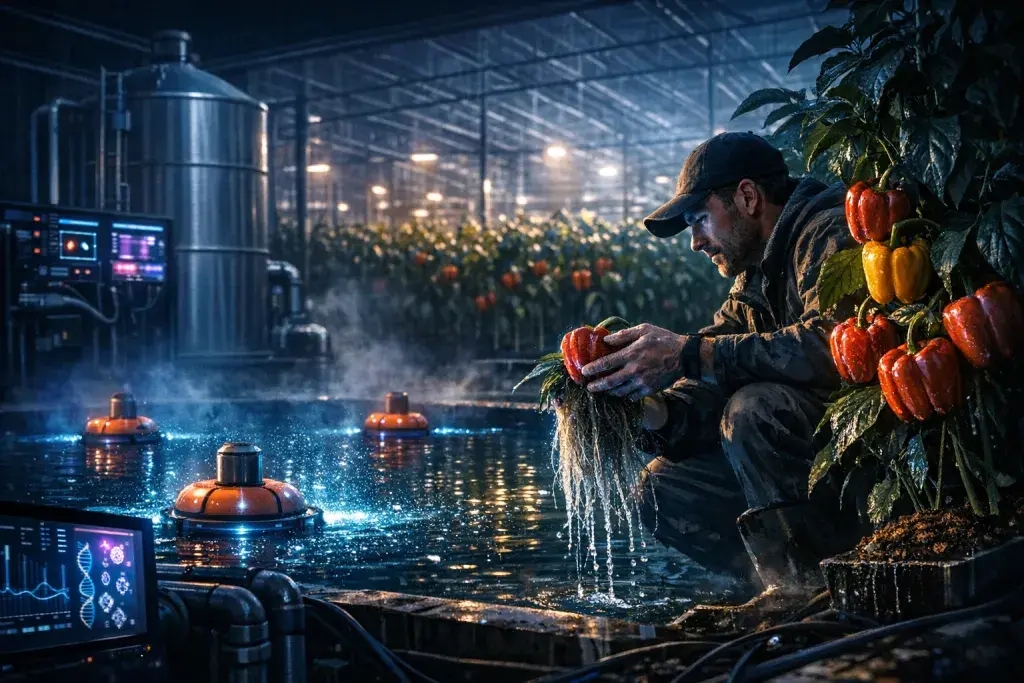
For over four years, Fresh Venture Farms has partnered with Ultramins to deploy USAF™ DT-100 transmitters, which use cavitation and ultrasound to treat water. These devices, submerged under orange buoys in ponds and extended to silos and daily supply lines, disrupt pathogens like Fusarium and Pythium. DNA sequencing from A&L Laboratories confirmed their effectiveness, showing high pathogen levels eliminated in treated samples.
Florian Locher, a key figure at the farm, reports that hydrogen peroxide (H₂O₂) consumption dropped more than 50%, saving $0.10–$0.15 per square meter annually. Last year's addition of nanobubble technology complemented this setup, allowing the farm to forgo all synthetic disinfectants. No other chemical agents enter the system, yet water stays pathogen-free.
Roots and Yields Transform
Photos from the farm reveal stark improvements in root health over the growing season. Before, roots showed stress; now they remain vigorous throughout. This shift eliminated pathogen issues entirely, cutting costs per square meter by 40–50% and delivering return on investment in under six months.
Production now heads toward 35+ kg per square meter by 2025. The farm recycles 100% of its water—a feat possible only with reliable cleanliness. Locher calls it a "no-brainer" for other bell pepper operations, starting small in ponds before scaling up.
Broader Push for Clean Irrigation
Greenhouse growers face constant pressure from waterborne diseases that spread via recirculated systems. Traditional disinfectants like hydrogen peroxide work but add expense and residue risks. Ultrasonic cavitation generates shock waves and micro-bubbles to rupture pathogen cells mechanically, offering a chemical-free alternative that aligns with demands for lower inputs and closed-loop water use.
This case at Fresh Venture Farms demonstrates real-world scalability. By simplifying irrigation management, such technologies free growers to focus on crop performance amid rising food production needs. Other operations may follow, especially as water scarcity intensifies in controlled agriculture environments.