Finland's commuter-rail network faces its most significant summer disruption in recent memory, with HSL's 2026 works programme shutting key sections of the Helsinki metropolitan rail system from 1 June through early September. For companies moving people in and out of the region - and for mobility managers responsible for those itineraries - the window for advance planning is already closing.
What Closes, What Thins, and for How Long
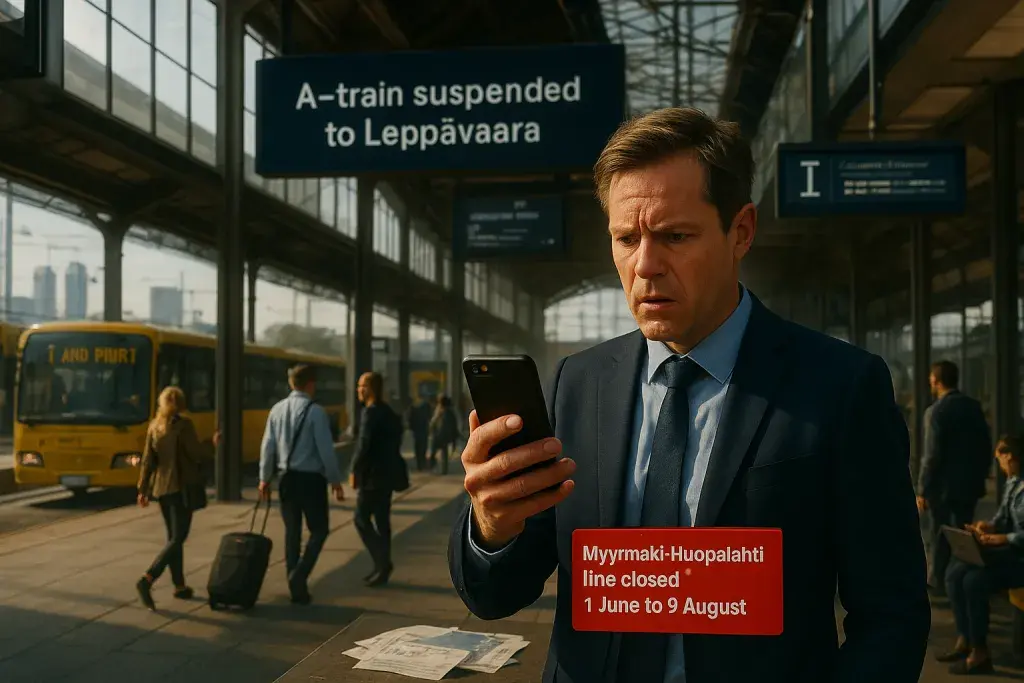
The headline impact is a complete break in rail traffic between Myyrmäki and Huopalahti running from 1 June to 9 August. That segment carries the I and P airport loops, which means passengers relying on those routes to reach Helsinki-Vantaa Airport will need to switch to replacement buses or find alternative rail connections. Neither option replicates the directness or timing of the original service.
The A-train - the service connecting Helsinki Central to Leppävaara, a district that functions as one of the region's primary tech and professional business hubs - will not run at all this summer. That is not a thinned timetable; it is a full suspension. For companies with staff based in or regularly visiting Leppävaara, that changes the planning calculus entirely. And for long-distance services west of Leppävaara, five weeks of cuts after Midsummer further compress options on the corridor.
Airport connectivity degrades in a subtler but operationally significant way. I-trains serving Helsinki-Vantaa will skip four suburban stations and drop to a 20-minute frequency outside peak hours, compared with the usual ten-minute intervals. Flights themselves are unaffected - but journey times between the airport and the city centre will lengthen. For anyone building tight schedules around early-morning departures or late arrivals, that margin disappears.
The Business District Problem
The disruption hits hardest in the Espoo corridor. Keilaniemi and Otaniemi - home to corporate headquarters, university research operations, and a dense cluster of technology firms - depend on the same rail infrastructure that is now being rebuilt to support the 2028 introduction of new commuter rolling stock. The irony is plain: the works that will eventually improve capacity are, in the short term, forcing exactly the kind of mobility pressure those districts least want.
Employers in those areas have a narrow set of practical responses. Staggered start times reduce the collision between staff commute peaks and compressed bus-replacement services. Remote-work flexibility, where roles permit, removes the problem rather than managing it. Travel-approval systems and corporate booking tools should be updated now - not in May - to build mandatory buffer time into any itinerary that touches the affected lines. A 20-minute transfer assumption that worked in 2025 may need to become 45 minutes for the duration.
Car-rental operators and ride-hail services are already anticipating higher demand across the affected period. That means prices will likely reflect it, and availability during peak business-travel windows - Monday mornings, Thursday evenings - may tighten. Mobility managers who haven't pre-arranged ground transport alternatives are going to be managing this reactively, which costs more and delivers worse outcomes.
International Travellers Face a Layered Problem
For international visitors arriving during this period, the rail disruption is one complication among several. Entry formalities vary significantly by nationality, and the administrative burden of visa applications, consulate appointments, and document processing adds lead time to any trip that isn't purely within the Schengen zone's frictionless travel arrangements. HSL's works programme runs from June through early September - overlapping with peak conference season, Nordic business summits, and the Espoo tech calendar.
VisaHQ's Finland-specific platform at https://www.visahq.com/finland/ consolidates current entry requirements and handles online applications for a broad range of nationalities, with optional courier and passport-collection services for those who cannot easily attend a consulate in person. For corporate travel teams managing multiple inbound guests from varied origin countries, that kind of consolidated, current-information resource reduces the risk of last-minute visa complications landing on top of an already compressed transit window.
Planning Around Disruption, Not Against It
HSL has committed to real-time disruption alerts through its mobile app and Twitter feed, and the Reittiopas journey planner operates fully in English - which matters for international staff who can't parse Finnish service notices. Accessibility buses will operate for passengers with reduced mobility at closed stations, and replacement bus links are in place across affected sections. That infrastructure exists. The question is whether travellers and their companies know about it before they land, not after.
The broader works programme is essential infrastructure investment - track upgrades, bridge repairs, and the Espoo City Rail project that will shape the network's capacity for the next decade. That context doesn't soften the summer disruption, but it reframes the response: this is a defined, time-bounded operational constraint with a clear end date. Companies that treat it as a planning problem - adjusting commuter policies, updating itinerary tools, communicating proactively with staff - will absorb it. Those that don't will spend the summer reacting to missed connections and client delays one trip at a time.