
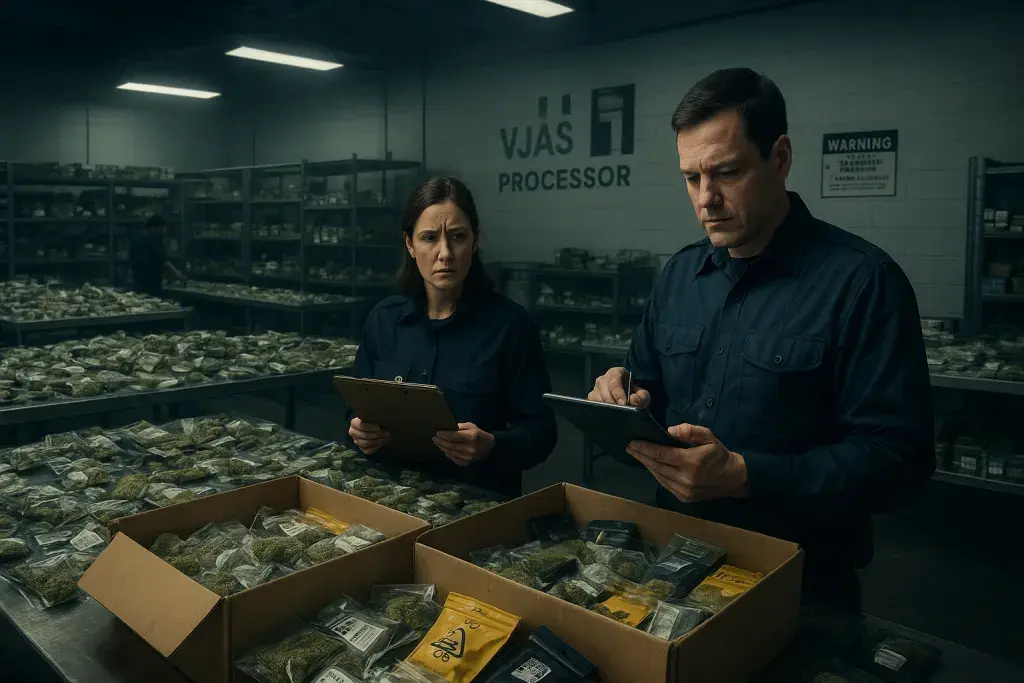
A Michigan cannabis processor is facing license-threatening consequences after state inspectors uncovered more than 12,000 individual cannabis products at its Harrison Township facility that lacked Metrc tags or any identifying information. The Michigan Cannabis Regulatory Agency (CRA) has filed a formal complaint against VJAS 1, alleging that some of the untagged products appeared to originate from California - a finding that points toward far more serious problems than a simple recordkeeping lapse. The company now faces potential fines, suspension, revocation, restriction, or refusal to renew its operating license.
Seed-to-sale tracking is the foundational requirement of regulated cannabis commerce in Michigan and across every adult-use state with a functioning compliance framework. Every product that enters or leaves a licensed facility is supposed to carry a Metrc tag - a unique identifier that logs movement, ownership, and chain of custody from cultivation through final sale. Operators in other states building out their compliance infrastructure, whether they're using a marijuana pos maryland integration or any other state-specific tracking solution, understand this basic premise: untagged inventory is, from a regulatory standpoint, inventory that doesn't officially exist. At VJAS 1, inspectors found not a handful of untagged items but more than 12,000 - a volume that strains any explanation rooted in clerical error or system glitch.
What makes this case harder to dismiss as administrative sloppiness is the nature of what inspectors found mixed in with the untagged inventory. Products in California-specific packaging - displaying "CA" and California-mandated warning language - were sitting inside a Michigan-licensed processing facility. Employees on site reportedly could not explain how those products got there or why so many items were unaccounted for. That's not a paperwork problem. It's a red flag for potential diversion, interstate product movement, or the operation of an unlicensed supply channel running parallel to a licensed one. Regulators designed Metrc precisely to make this kind of activity difficult to hide. When a facility holds thousands of products outside the system, the tracking infrastructure can't do its job.
The Tagged Products Tell a Second Story
Here's where the enforcement picture gets more serious. Inspectors did find some products with valid Metrc tags at the VJAS 1 facility. That might sound like partial credit - proof that at least some inventory was being tracked properly. It wasn't. When CRA investigators cross-referenced those tagged products against the statewide system, they found the items were supposed to be located at other licensed cannabis businesses entirely. Metrc tags don't just confirm a product's identity; they establish where it's supposed to be at any given time. Finding tagged inventory in the wrong facility is not a clerical mismatch - it suggests products were physically moved between licensees in ways that were either not recorded or actively concealed in the system.
For anyone operating in the licensed cannabis supply chain, this is the detail that warrants the most attention. Wholesale transfers between licensed businesses require documentation, manifests, and system-logged transfers at both ends. Products don't migrate between facilities on their own. The presence of correctly tagged products assigned to other operators raises questions about whether those other businesses were aware their inventory was elsewhere - and whether their own compliance records reflect accurate stock counts.
What the Enforcement Action Means for Operators
VJAS 1 is a processor, not a retail dispensary - but the compliance exposure here is instructive for operators at every license type. Processors sit in the middle of the supply chain. They receive raw material from cultivators, transform it into finished products, and send those products downstream to retailers and dispensaries. That position gives processors visibility - and responsibility - across a wide range of inventory flows. Maintaining accurate Metrc records isn't optional overhead; it's the mechanism by which the state confirms the licensed market is operating as a closed system, separate from unregulated supply.
The CRA's complaint puts the full range of licensing consequences on the table: fines, suspension, restriction, and outright revocation. Michigan's adult-use market is competitive and licensing isn't inexpensive to obtain or maintain. Operators who treat Metrc compliance as a back-office function rather than a core operational discipline are carrying real license risk - not theoretical risk. Facilities with large, complex inventories and high SKU counts face more surface area for tracking errors, which is an argument for tighter internal auditing, not looser attention to system entries.
The broader signal from cases like this one is that regulators with inspection authority will use it. Untagged products in volume, out-of-state packaging, and inventory appearing in the wrong facility are the kinds of findings that don't resolve with a warning letter. They generate formal complaints, public records, and license jeopardy. For licensed operators, that's the operational reality the Michigan CRA just put back on the table.