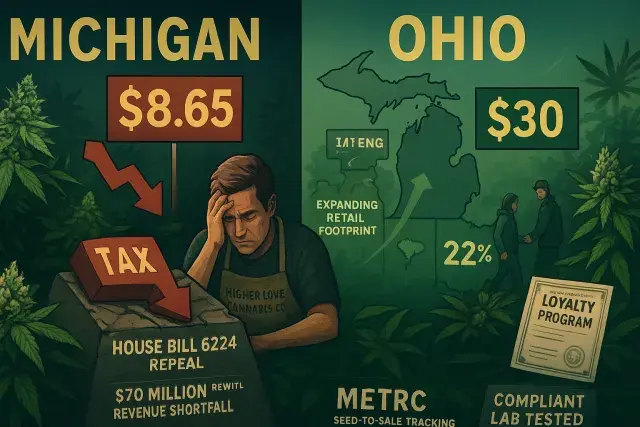
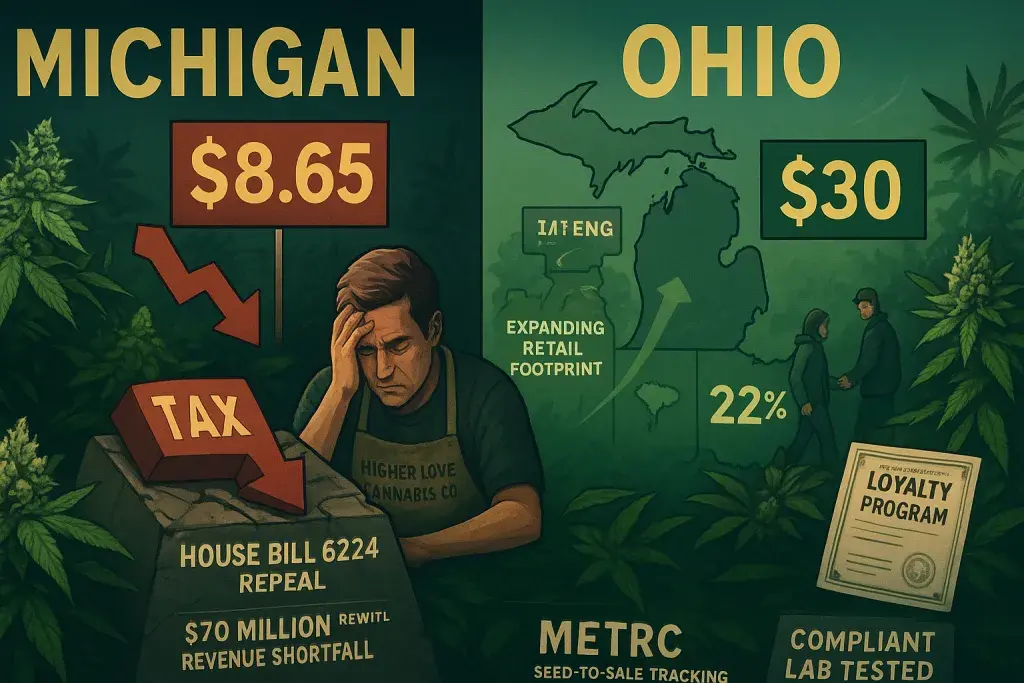
Michigan and Ohio's cannabis markets are heading in opposite directions, and the split says something bigger about where the Midwest marijuana business is headed. Michigan sales fell 5.1% year over year in July, while Ohio's much younger recreational market jumped 22%. The divergence is putting fresh scrutiny on Michigan's new 24% wholesale marijuana tax, and on whether Lansing has finally pushed a hyper-competitive market past what it can absorb.
A Cheap Market Meets a New Cost
Michigan retailers sold roughly $260.6 million in July, still dwarfing Ohio's $111.4 million. But the average item price in Michigan was just $8.65 - the lowest among major U.S. markets tracked by Headset. That's the product of years of oversupply: too much flower, too many cultivation licenses, too much retail competition chasing a limited number of consumers. Fair enough, cheap weed has been great for shoppers. It has not been great for the people trying to run a compliant, tax-paying business on razor-thin margins.
Layer a 24% wholesale tax on top of that, and the math gets uglier fast. The levy, which took effect Jan. 1, applies before the retail excise tax and sales tax consumers already pay. For growers and processors operating on wholesale menus with prices already compressed by oversupply, that's another line item eating into whatever margin was left. Higher Love Cannabis Co., an Upper Peninsula operator, suspended operations at five of its nine Michigan dispensaries this month, specifically citing the wholesale tax as compounding pressure from falling prices and shrinking revenue.
The Repeal Push and Its Revenue Problem
State Rep. James DeSana has introduced House Bill 6224, a one-sentence bill that would repeal the wholesale tax outright. His argument isn't just that the tax hurts operators - it's that it's underperforming. He says the levy generated roughly $70 million less than projected in the fiscal year's first four months, with a possible $210 million annual shortfall against the original $420 million target for the neighborhood road fund.
That's the uncomfortable irony for lawmakers. A tax designed to extract revenue from a booming industry only works if the industry stays healthy enough to generate taxable volume. If dispensaries close, cultivation licenses shrink, and consolidation accelerates - which CRA license data already shows happening, particularly among growers - the tax base erodes underneath the policy. The bill now sits in the House Appropriations Committee, and the wholesale tax also faces ongoing legal challenges from industry litigants.
Ohio's Higher Prices, Michigan's Volume Problem
Here's the catch: Michigan isn't selling less marijuana in any meaningful sense. Consumers bought more than 30 million individual products in July and remain on pace to move over 1.3 million pounds of flower in 2026 - essentially flat with last year. The problem isn't demand. It's that dollar sales can fall even as unit volume holds, because prices have been squeezed so hard.
Ohio is the mirror image. Its average item price runs around $30 - more than three times Michigan's - and its market is still expanding as licensing and retail buildout catch up to demand. That price gap has long pulled Ohio consumers across the border into Michigan dispensaries, particularly in border communities. Whether that keeps happening depends on how much of Michigan's price advantage survives further tax pressure and business attrition.
- Michigan: high volume, historically low prices, declining dollar sales, wholesale tax pressure on margins
- Ohio: smaller but growing market, substantially higher prices, expanding retail footprint
- Shared risk: both states depend on tax and license structures that assume continued market health
What Operators and Regulators Should Watch
For multi-state operators and independent dispensaries alike, Michigan's situation is a case study in how tax design interacts with an oversaturated supply chain. A wholesale tax hits hardest when margins are already compressed by 280E's federal tax treatment, competitive discounting, and loyalty-program price wars at retail. Landlords, payment processors, and point-of-sale vendors serving Michigan operators should expect continued consolidation - fewer active licenses, more closures, more cautious lease renewals - regardless of how the repeal effort plays out in Lansing.
None of this changes the underlying compliance basics that still matter to consumers and regulators: age-gated retail access, lab-tested products with valid COAs, compliant packaging, and seed-to-sale tracking through METRC remain the baseline for legal operation in both states. But the business case for staying in that system gets harder every time a new tax lands on top of a market already selling product near cost. Michigan's challenge now is proving that a high-volume, low-price model can survive its own tax policy - before Ohio's higher-margin market closes the distance.