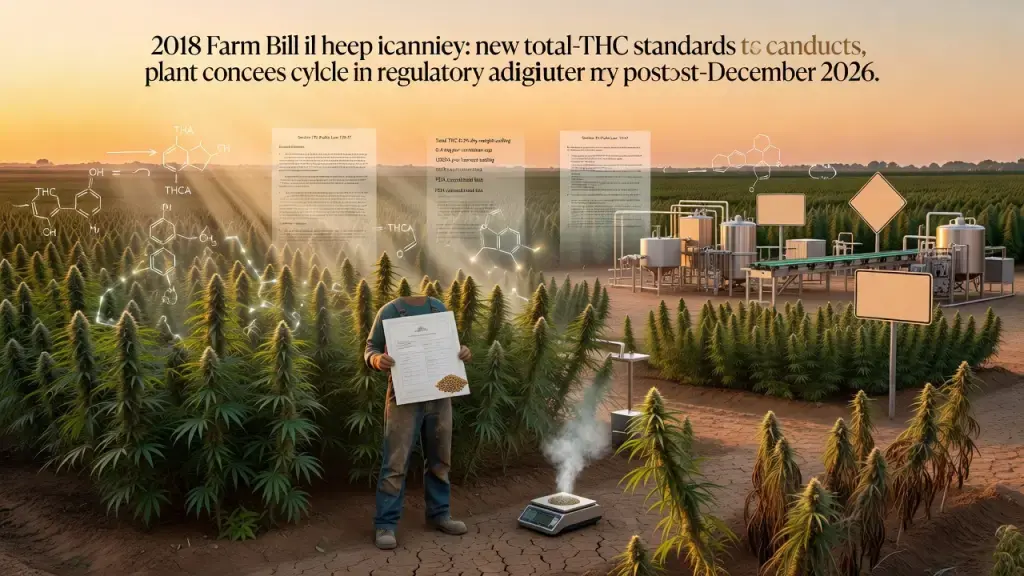
A provision tucked into a November 2025 federal funding package is rewriting what counts as legal hemp, and the industry still doesn't have the guidance it needs to comply. Section 781 of Public Law 119-37 replaces the old delta-9 THC threshold with a "total THC" standard that folds in THCA, sets a 0.4 milligram per-container cap on certain finished cannabinoid products, and redefines what counts as hemp at the seed level. Implementation was pushed from November 2026 to December 11, 2026, but the underlying law hasn't changed, and the FDA has already blown past its own deadline to publish the cannabinoid lists the statute requires.
Why the Old Definition Broke Down
The 2018 Farm Bill measured hemp by delta-9 THC alone, on a dry-weight basis. That left out THCA, the acidic precursor that converts to delta-9 THC when heated. The gap was not a technicality - it became a business model. Flower could test compliant on paper while containing enough THCA to be functionally indistinguishable from state-licensed cannabis. Lab certificates of analysis reported one number; combustion or vaporization produced another result entirely. Lawmakers wrote a chemistry-dependent threshold without fully accounting for how cannabinoids behave, and the market built itself around that blind spot.
Edibles made the gap harder to ignore. A five-gram gummy at the old 0.3% delta-9 threshold could legally carry 15 milligrams of THC - well above the 10 milligram serving cap common in many adult-use markets. That's not a loophole dreamed up by bad actors; it's arithmetic built into the statute itself.
What Changes for Growers and Processors
Section 781 now measures total THC, including THCA, against a 0.3% dry-weight ceiling - and that single change collides with basic plant biology. THC and CBD concentrations tend to rise together as cannabis matures. Cultivars bred for commercially viable CBD yields routinely cross 0.3% total THC by harvest, even when they tested compliant during the mandatory pre-harvest sampling window required under USDA rules. Processors who built supply chains around high-CBD biomass may be forced toward lower-yielding cultivars, which means more acreage, more biomass handling, and higher costs per unit of CBD extracted - a margin squeeze that lands on farmers first and manufacturers second.
- Total THC now includes THCA, not just delta-9 THC, for hemp classification purposes
- Finished cannabinoid products face a 0.4 mg per-container limit for total THC and similarly acting cannabinoids
- A new "intermediate hemp-derived cannabinoid product" category excludes material exceeding 0.3% combined THC or sold directly to consumers as a final product
- Viable hemp seeds are excluded from the hemp definition if the source plant exceeds 0.3% total THC - but the law doesn't specify when in the plant's life that measurement applies
Unresolved Questions That Matter for Compliance
Nobody has answered whether raw flower sold to consumers counts as a "final" product subject to the 0.4 milligram cap, or as an intermediate product governed by different rules. Nobody has clarified whether USDA's existing 30-day pre-harvest testing window still controls compliance, or whether total THC must stay under threshold all the way through harvest and processing. For breeders and seed producers, the seed-eligibility provision raises a parallel problem: source-plant THC can shift meaningfully between early testing and full maturity, and the statute doesn't say which point governs. Until the FDA publishes its court-ordered cannabinoid lists and USDA clarifies testing protocols, operators are left guessing which genetics, products, and supply agreements will still be legal after December 2026.
The Stakes for an Industry Built on Narrow Margins
This is not simply a labeling fix. If total-THC compliance is enforced at full plant maturity rather than at the existing pre-harvest testing point, a large share of commercial CBD genetics could fall outside the legal definition of hemp entirely - genetics that took years and real capital to develop. Smaller farms and independent breeders, who generally lack the acreage or capital reserves to absorb a sudden need for lower-yield cultivars, stand to lose ground to larger operations with more flexibility. Consumers who rely on full-spectrum products, as distinct from isolated cannabinoids, could see fewer options on shelves. None of this excuses the real consumer-safety problem the law is trying to address - intoxicating products sold with inconsistent labeling and inadequate testing deserve scrutiny. But a statute that doesn't distinguish between a gas-station delta-8 vape and a compliant, lab-tested CBD tincture risks solving one problem by creating several more.