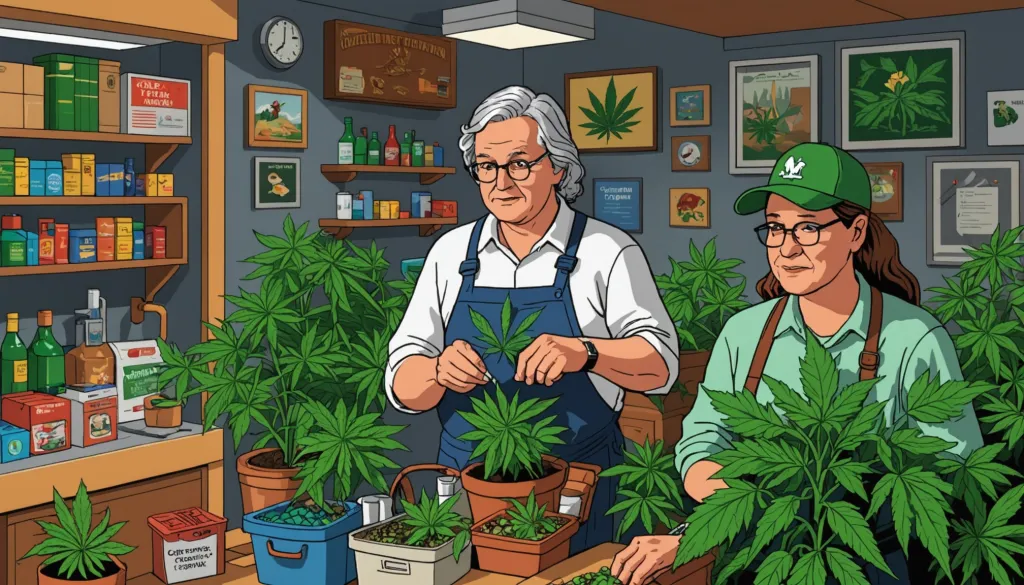
Michigan's marijuana industry has spent years drowning in its own supply. Prices keep falling, margins keep shrinking, and operators keep asking the same question: where are the customers going to come from? New federal survey data and Michigan-specific research point to an answer that most retail strategies haven't accounted for - people in their 50s, 60s and beyond, many of whom are returning to cannabis after decades away from it.
The numbers are notable. Nearly 22 percent of Americans ages 55 to 65 reported using cannabis in the past year, according to the Monitoring the Future survey conducted by the University of Michigan and highlighted by NORML - the highest share the survey has ever recorded. Applying national spending patterns tracked by Headset, Baby Boomers account for roughly 12.6 percent of cannabis purchases nationally. Run that percentage against Michigan's 2025 cannabis sales and Ohio's first full year of adult-use sales, and the combined Baby Boomer market across both states comes out to somewhere around half a billion dollars annually. That's a MITechNews estimate built from national purchasing patterns, not a state-reported figure - Michigan's regulator doesn't break out sales by generation, and neither does Ohio's. Retailers looking to build loyalty programs or POS segmentation around this cohort will need better instrumentation, which is part of why platforms like the best-rated cannabis dispensary software new york operators rely on have started emphasizing customer analytics rather than just transaction processing.
Why This Customer Doesn't Shop Like the Others
Here's the catch: selling to a 65-year-old isn't the same business as selling to a 25-year-old, and dispensaries built around high-potency flower and rapid SKU turnover may not be set up for it. University of Michigan polling on healthy aging found that among cannabis users 50 and older, the top reasons for consumption were relaxation, sleep support, and pain management - not chasing the highest THC percentage on the shelf. That points toward demand for lower-dose edibles, tinctures, topicals and balanced THC-CBD ratios rather than the concentrate and vape categories that dominate marketing aimed at younger consumers. For budtenders, that means a shift from selling potency to explaining it.
Service, Not Just Discounting, May Be the Differentiator
Michigan has become one of the cheapest cannabis markets in the country, with average flower prices dropping below $60 an ounce in early 2026, even as a new 24 percent wholesale tax adds pressure from the other direction. Competing purely on price is a race to the bottom that many operators are already losing. Older consumers, particularly those returning to cannabis after thirty or forty years away, may respond less to another discount bin and more to informed staff who can walk them through dosage, product format and drug-interaction basics - a service model that's hard to automate and harder for low-margin competitors to replicate.
Compliance and Consumer Safety Can't Be an Afterthought
Marketing to older adults raises real compliance questions that retailers and regulators can't skip past. Today's cannabis products are far more potent than what many Boomers remember from decades ago - 83 percent of Michigan adults 50 and older agree today's cannabis is stronger than it was 20 or 30 years back, according to the University of Michigan poll. Older consumers are also more likely to be on prescription medications, which raises interaction concerns that dispensary staff are not qualified to resolve. The same survey found that among Michigan consumers 50 and older, 21 percent reported driving within two hours of using cannabis at least once in the past year, and roughly a third of monthly users had never discussed their cannabis use with a health care provider.
- Retailers must avoid unsupported medical claims tied to sleep, pain, or mood products.
- Age verification and compliant packaging remain non-negotiable regardless of the customer segment.
- Staff training on dosage and drug interactions is an operational necessity, not a marketing feature.
- Lab-tested COAs and clear labeling matter more, not less, for consumers unfamiliar with modern potency levels.
None of this solves Michigan's oversupply problem outright, and it certainly doesn't apply to Ohio's still-developing recreational market in the same way. But it does challenge the assumption that both states have already reached every willing customer. For operators searching for margin in a market that's been unkind to them, the next growth segment may not be found in new product drops or lower prices - it may be found in a demographic the industry has largely ignored until now.