Thailand completed one of the sharpest regulatory reversals in modern cannabis policy when its government reclassified cannabis flower as a controlled herb in June 2025, ending the loosely regulated retail boom that had followed the 2022 decriminalization and replacing it with a prescription-based, medical-only framework. For licensed dispensaries still operating in Bangkok, that shift rewired every part of the customer experience - from how staff greet walk-in tourists to how prescription documentation gets logged and stored. The margin for operational error is no longer abstract; shops that sell cannabis without verifying valid prescription documentation face up to one year imprisonment and a fine of up to 20,000 THB.
The compliance pressure here has a parallel in other regulated markets that went through rapid formalization after an initial period of loose enforcement. Operators familiar with how marijuana pos oregon systems evolved to handle OLCC compliance requirements - audit trails, age verification at point of sale, purchase limits tied to individual transaction records - will recognize the structural challenge Bangkok dispensaries now face: building documentation workflows fast enough to stay licensed while still serving a tourist-heavy customer base that often walks in with no prior knowledge of the medical framework.
What makes Thailand's situation operationally distinct is the tourist variable. Oregon retailers largely serve residents who can be expected to carry government-issued ID and understand the purchase structure. Bangkok's licensed dispensaries serve a rotating population of international visitors, many arriving with assumptions formed during the 2023-2024 period when recreational purchases required nothing more than walking through a door. That gap between tourist expectation and current legal reality is where compliance failures - and enforcement actions - actually happen.
What the Medical Framework Requires, Operationally
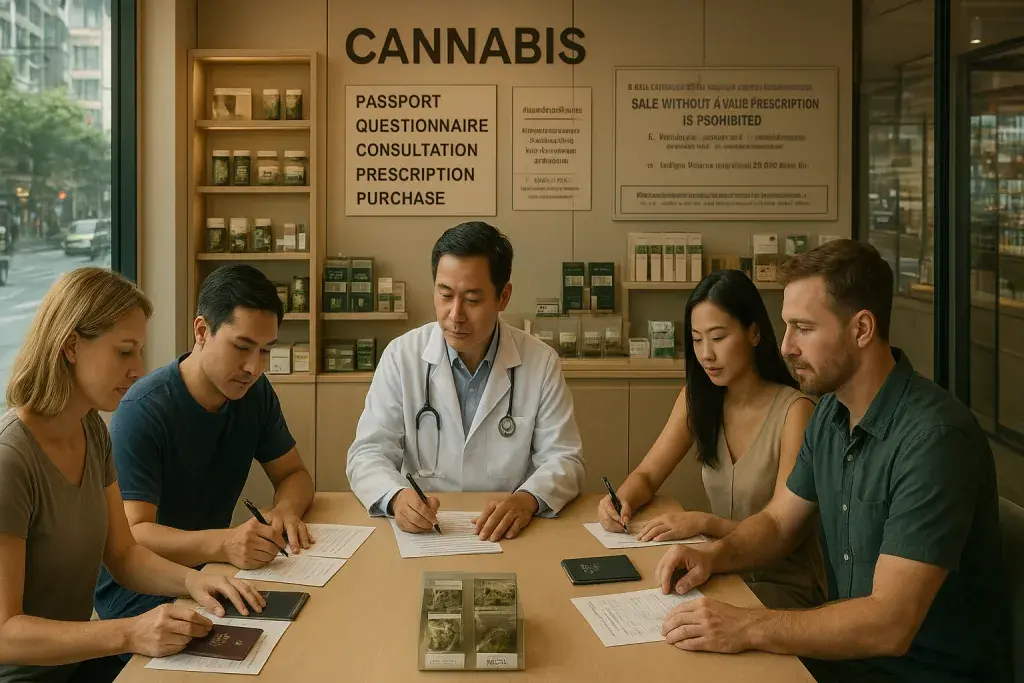
The legal access pathway for tourists runs through a consultation and prescription process, and licensed dispensaries that serve international visitors have had to build that process into their floor operations. A compliant transaction requires the customer to present a valid passport, complete a medical questionnaire covering recognized indications such as chronic pain or sleep issues, receive a consultation with a licensed Thai practitioner on-site, and obtain prescription documentation - commonly referred to as the PT33 form - before any cannabis flower changes hands. Prescriptions are capped at a 30-day supply per issuance.
That is not a minor add-on to a standard retail transaction. It requires dispensaries to staff or contract licensed medical practitioners, maintain consultation records, and link prescription documentation to sales records in a way that can withstand regulatory scrutiny. Shops that did not adapt to these requirements account for a significant portion of the more than 7,000 cannabis businesses that reportedly did not renew their licenses under stricter compliance rules, according to Public Health Ministry figures reported in late 2025 and early 2026. The market contraction was not a single overnight event - it was a phased shakeout tied to license non-renewals as compliance costs became real rather than theoretical.
For dispensaries that remained licensed, the operational model now resembles a hybrid between a pharmacy consultation and a retail transaction more than the freestanding retail shop model that characterized the 2022-2024 period. That is a meaningful shift in staffing, physical layout, and customer throughput. A walk-in tourist who expects to browse a product menu and pay at a counter will encounter a different sequence - questionnaire, consultation, documentation, then purchase - and dispensaries that have not trained staff to explain that sequence clearly are creating friction that increases the risk of non-compliant workarounds.
The Penalty Structure and Its Implications for Operators
Thailand's enforcement framework applies pressure from multiple directions simultaneously, which is worth understanding precisely. Public smoking carries up to three months imprisonment, a fine of up to 25,000 THB, or both under the Public Health Act - and that rule predates the 2025 changes, having been in place since 2022. What changed in 2025 was the explicit prohibition on recreational use, the prescription requirement for flower purchases, and the tightening of license compliance standards that triggered the market contraction.
For foreign nationals, a conviction carries consequences beyond the fine or imprisonment itself. Immigration implications - including deportation, visa complications, and future entry restrictions - are realistic outcomes. That asymmetry matters to dispensary operators because a tourist who encounters legal trouble after purchasing from a non-compliant shop creates reputational exposure for the entire licensed market, not just for the individual seller.
The sales-without-prescription penalty - up to one year imprisonment and a 20,000 THB fine - applies to shops, not just to individual staff members. That creates a direct incentive for operators to build prescription verification into their point-of-sale process rather than treating it as a back-office compliance function. The parallel to age verification requirements in U.S. licensed markets is close: the liability attaches to the transaction, and "we were busy" is not a defense.
What the Bangkok Market Looks Like Now, and What It Means for the Industry
Licensed, tourist-facing dispensaries still operate in Bangkok's main commercial corridors - the Sukhumvit belt from Nana through Ekkamai, the Silom and Sala Daeng area, and the Khao San Road zone - but the operating environment is fundamentally different from the period many travelers remember. Product pricing varies widely by type and quality: flower generally runs from roughly 60 THB per gram at the low end to 400 THB and above for premium product, with pre-rolls, edibles, and vape products layered on top. Consultation fees are set by individual clinics and dispensaries rather than a fixed government schedule, so total cost of access is variable.
The broader implication for the regulated cannabis industry globally is the same lesson that U.S. markets learned after their own early periods of loose enforcement: rapid legalization without robust compliance infrastructure produces a correction. Thailand's correction was sharp - from an estimated 10,000-plus shops at the peak to a significantly contracted licensed market in under three years. The shops that survived are, generally, the ones that built real compliance capacity rather than relying on regulatory ambiguity. That is not unique to Thailand. It is the pattern of how cannabis markets mature, and operators anywhere in the world who are watching Bangkok's transition closely will find it familiar in its mechanics, even if the specific legal framework differs from anything in their home jurisdiction.
One rule applies regardless of jurisdiction: anything purchased legally in Thailand must stay in Thailand. Carrying cannabis or plant parts across any border - including for tourists returning to countries with legal cannabis markets - is prohibited, and export can trigger serious trafficking charges. That is not a technicality. It is the hard boundary around every other legal pathway described above.