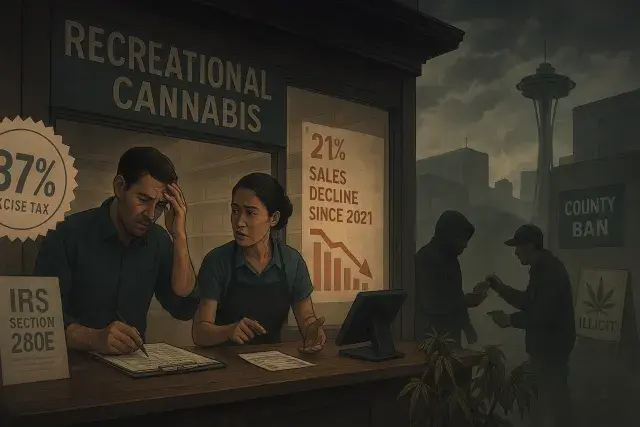
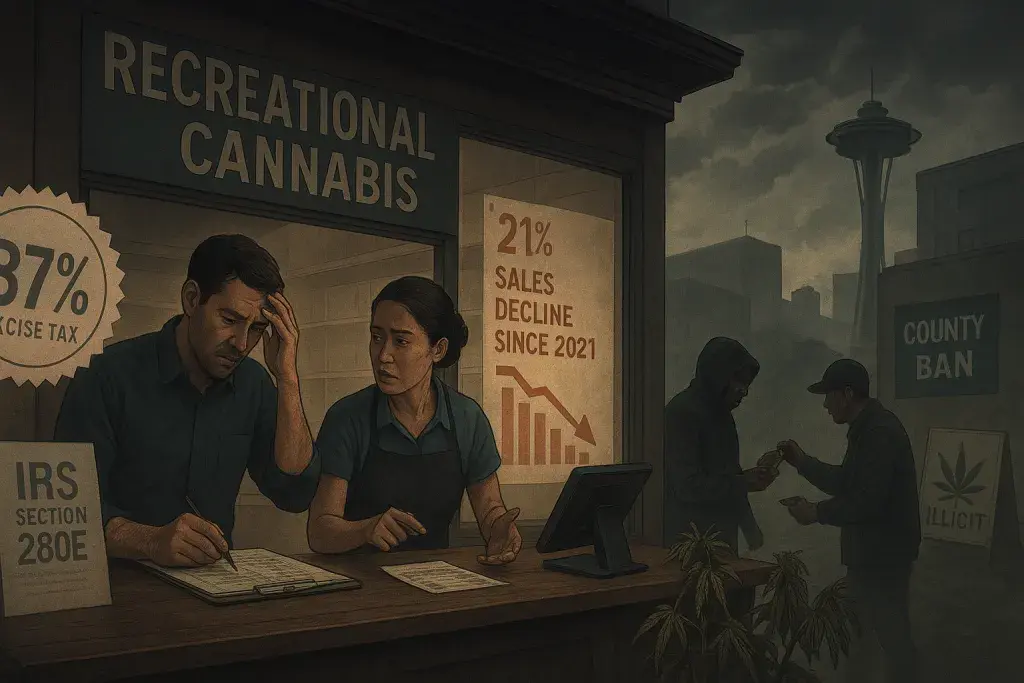
Washington state's licensed cannabis market generated roughly $1.14 billion in retail sales in 2025 - down slightly from $1.18 billion the year prior, and a full 21% below the $1.4 billion peak recorded in 2021. The decline is not a blip. It reflects a market under sustained structural pressure from oversupply, punishing tax obligations, and an illicit market that, by some estimates, now accounts for nearly half of all cannabis consumed in the state.
For dispensary operators watching those numbers, the math is bleak in a way that goes beyond year-over-year comparisons. The operational model that worked during the early growth years - strong wholesale pricing, healthy margins, steady foot traffic - has been compressed from multiple directions simultaneously. Operators in other states dealing with similar maturation pressures have turned to technology to tighten unit economics; robust point-of-sale for Ohio dispensaries and comparable platforms elsewhere have helped retailers sharpen inventory controls, reduce shrinkage, and better manage wholesale menus as margins contract. Washington retailers face the same operational imperative, but with a tax structure that leaves far less room for error.
A Tax Rate That Narrows Every Margin
Washington's 37% excise tax on retail cannabis is already the highest recreational rate in the country. Layer on the federal constraints embedded in Internal Revenue Code Section 280E - which bars state-licensed cannabis operators from deducting ordinary business expenses, because the federal government still classifies cannabis as a Schedule I controlled substance - and the effective tax burden on some Washington businesses can approach 70%, according to analysis from Whitney Economics. To put it plainly: a retailer pulling in a million dollars in gross revenue might clear far less than a conventional small business would on the same top line, simply because the IRS won't allow standard deductions for cost of goods, payroll, or rent that every other retailer takes for granted.
That disparity isn't just painful for operators - it actively distorts consumer behavior. When the cost of compliance gets baked into retail prices, consumers who are price-sensitive have an obvious alternative: the illicit market, which carries none of those tax obligations and prices accordingly. Washington CannaBusiness Association spokesperson Aaron Pickus put it directly to KUOW: "If the tax rate, as we believe, is pushing people into the untaxed illicit marketplace, then we've got to look at the tax rate as one of the barriers to a safer choice." Economic analyses cited by Pickus suggest roughly half of cannabis consumed in Washington moves through unregulated channels. That's not a fringe problem. That's a structural failure of the legal market's value proposition.
Oversupply Has Been Building for Years - and It Shows
The production side of Washington's market tells its own uncomfortable story. Licensed growers produced 121,254 pounds of THC in 2017, already nearly double what retailers sold that year. By 2023, production had tripled to more than 363,000 pounds - while sales only doubled. That gap between what's being grown and what's being sold through licensed channels has persistently suppressed wholesale pricing, squeezing producer and processor margins to the point where annual attrition among those licensees reached 20% in 2022, compared with 7% among retailers, according to a July 2025 report from the state's Joint Legislative Audit and Review Committee.
Dewey Scientific co-founder Jordan Zager described the downstream effect to the Tri-Cities Area Journal of Business in stark terms: "A lot of our colleagues are closing. The volume of product moving from producer to retailer has severely declined, down 60% in just a year." That kind of volume collapse ripples through the entire supply chain - fewer SKUs moving through the wholesale menu, tighter compliance logs with fewer transactions to log, and producers who can't sustain operations long enough to recoup licensing and buildout costs.
Rescheduling Relief Probably Won't Reach Most Washington Operators
Federal moves to reschedule cannabis from Schedule I to Schedule III have generated considerable optimism in some corners of the industry. Here's the catch for Washington: the state built its licensed market as a single adult-use recreational tier, rather than maintaining a separate medical cannabis program. Because 280E relief tied to rescheduling would most likely apply to medical cannabis licensees operating under a distinct medical framework, most Washington retailers and producers would remain fully subject to the existing federal tax restrictions. The rescheduling path, if it proceeds, benefits states with active, separately licensed medical programs more directly than it benefits a market structured the way Washington's is.
That distinction matters for operators, investors, and multistate operators assessing Washington exposure. The regulatory architecture of a state's licensing system - not just the federal schedule - determines whether federal tax relief actually lands where operators need it. Washington's relatively streamlined single-market structure, designed to simplify compliance and reduce gray-market carve-outs, turns out to be a liability in the rescheduling calculus.
What Licensed Operators Are Actually Up Against
County-level bans on cannabis retailers compound the access problem. When licensed dispensaries are prohibited from operating in certain jurisdictions, consumers in those areas don't stop buying cannabis - they buy from unregulated sellers. Every geographic gap in the licensed retail network is a gap that the illicit market fills, often permanently, because building consumer habits takes time and trust that licensed retailers never get the chance to establish in those communities.
The combined effect - oversupply suppressing wholesale prices, a 37% excise tax plus 280E compressing retail margins, illicit market competition capping what licensed retailers can charge, and local bans limiting geographic reach - represents a set of pressures that no single operational adjustment resolves. Retailers can optimize their POS workflows, sharpen inventory management, and reduce shrinkage; those improvements matter. But the core economics of the Washington market right now reflect a policy environment that has made it genuinely difficult for licensed businesses to survive, let alone grow. That's worth watching closely, because Washington's trajectory is one version of where other mature adult-use markets may be heading.