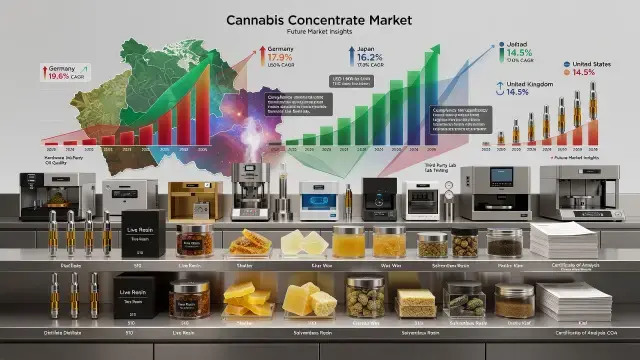
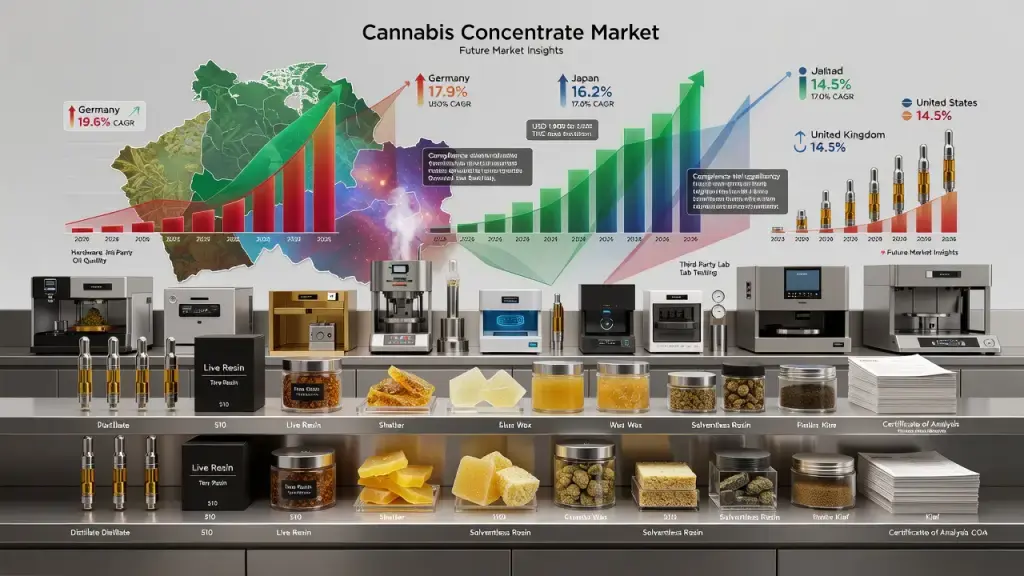
The global cannabis concentrate market is moving upmarket, and the numbers tell a clear story. Future Market Insights pegs the sector at USD 1.90 billion in 2026, with a climb to USD 9.00 billion by 2036 - a 17.0% compound annual growth rate over the decade. That growth isn't evenly distributed, though, and the reasons why matter more to operators than the headline figure itself.
Why Concentrates Are Pulling Ahead of Flower
Distillate, live resin, rosin, wax, shatter, crumble, hash, kief - the product list has gotten long, and each format answers a different consumer need. Vape cartridges remain the workhorse category because they solve for portability and discretion, two things flower simply can't offer. Standardized 510-thread hardware has made cartridges interchangeable across brands, which sounds like a small technical detail but actually reshapes competitive dynamics on a dispensary's wholesale menu. When hardware is compatible across SKUs, brand loyalty shifts toward oil quality and extraction method rather than device design.
At the top end, live resin and solventless rosin are commanding attention for terpene-rich profiles tied to specialized production methods. These products carry a production cost premium, and that premium shows up on the shelf. For operators, that means budroom inventory planning now has to account for a wider spread between entry-level distillate and premium solventless lines - different price points, different shelf life, different packaging requirements.
Extraction Investment Meets Regulatory Reality
Manufacturers are putting real capital into advanced extraction, including solventless technologies, chasing consistency and flavor retention rather than just yield. That's the manufacturing side. The compliance side is less forgiving. Third-party lab testing, hardware certification, and documented quality-control processes are becoming baseline requirements in markets where regulators tie product availability directly to a certificate of analysis. No COA, no shelf placement - that's the practical reality in most regulated jurisdictions now.
Here's the catch: regulatory frameworks differ sharply from one jurisdiction to the next, and concentrate producers can't simply copy a product line from one market into another. Licensing requirements, testing protocols, and restrictions on THC-containing products vary enough that a formulation compliant in one state or country may be entirely unmarketable in the next. That forces multi-market operators to build flexible compliance systems rather than a single standardized playbook.
Country-Level Growth Diverges From Global Averages
FMI's country-level projections show considerable spread. Germany is expected to post a 19.6% CAGR through 2036, Japan 17.9%, and the United Kingdom 16.2% - each shaped by its own regulatory posture rather than global demand trends. Japan's case is particularly instructive: its restrictive framework draws a hard line between permitted cannabinoid products and THC-containing concentrates, meaning growth there reflects a narrower, more tightly defined product category than in markets with broader adult-use access.
The United States, by contrast, is projected at a more modest 14.5% CAGR, with continued state-level adult-use legalization and established vape cartridge demand cited as the primary drivers. That's slower than several international markets on a percentage basis, but it starts from a larger existing base - a reminder that CAGR comparisons across markets of different maturity levels need context, not just ranking.
- Regulatory variation across jurisdictions directly limits product portability for multi-state and multinational operators
- Lab testing and COA documentation increasingly determine retail shelf access, not just consumer trust
- Hardware standardization (510-thread) is shifting competitive focus toward oil quality over device design
- Premium solventless products carry distinct cost, shelf-life, and packaging implications for inventory planning
What This Means for Operators and Distribution Partners
Licensed dispensaries remain the primary legal distribution channel where concentrate sales are permitted, and that's unlikely to change soon. What's striking here is how much of the forecast growth depends on factors outside any single company's control - the pace of regulatory change, the expansion of licensed retail infrastructure, and consumer adoption curves that vary by region. Businesses that pair reliable extraction processes with compliant packaging, consistent batch quality, and jurisdiction-specific distribution strategy are the ones positioned to hold ground as these regulated markets mature. Everyone else is simply betting on momentum.