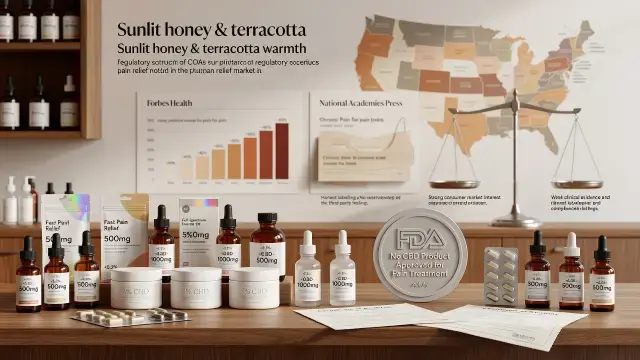
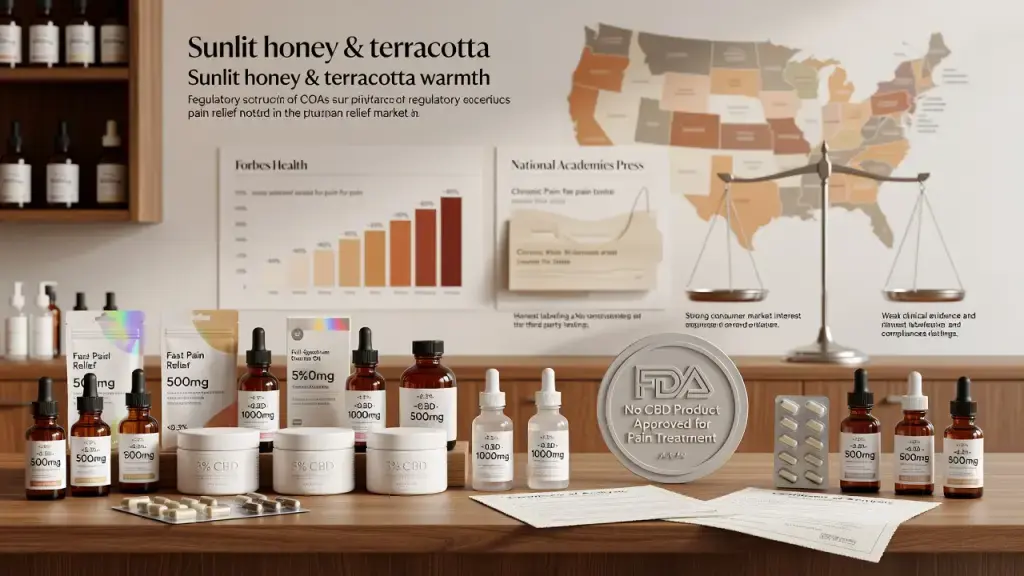
The CBD market for pain relief has matured past novelty status, but it still operates in a regulatory gray zone that puts real pressure on retailers, manufacturers and the consumers buying these products off shelves and websites. The FDA has not approved any CBD product to treat or prevent pain, a fact that shapes how brands can legally market these goods and how retailers should frame expectations for customers. That gap between consumer demand and regulatory approval is where most of the operational and compliance complexity lives.
Why Demand Keeps Outpacing Regulatory Clarity
A Forbes Health survey found roughly 60% of U.S. adults use CBD for pain relief, a figure that tells retailers something important: this is not a niche category anymore. Research reviewed by the National Academies Press suggests adults with chronic pain treated with CBD reported better outcomes than those who weren't, but that's observational ground, not FDA-sanctioned clinical proof. For brands and dispensaries, this distinction matters enormously. Marketing language that implies treatment or cure crosses a line regulators watch closely, and compliant packaging has to walk a careful path between consumer education and unsubstantiated claims.
The product mix itself reflects fragmented consumer need rather than a single winning format. Gummies, oils and topical creams each serve different pain profiles - generalized versus localized - which means inventory planning for retailers isn't one-size-fits-all. A dispensary or CBD specialty shop stocking only oral tinctures is leaving a segment of pain-focused shoppers without the targeted topical option many actually prefer.
Potency Variance Creates a Labeling Problem
Unlike standardized over-the-counter pain medication, CBD potency and formulation vary widely by manufacturer and extraction method. That inconsistency is a genuine operational headache. Retailers sourcing from multiple brands need to reconcile wildly different concentration claims - some creams marketed at 3% to 5% CBD by weight, others far lower - and present that information clearly to shoppers who may not understand the difference between full-spectrum, broad-spectrum and isolate formulations.
- Full-spectrum CBD contains THC plus the full range of naturally occurring terpenes and minor cannabinoids.
- Broad-spectrum CBD mirrors that profile but without THC.
- CBD isolate is stripped to pure CBD, with no THC, terpenes or other cannabinoids.
For compliance teams, this isn't just a labeling nuance - it's a legal one. Full-spectrum products legally need to stay under 0.3% THC by dry weight to remain federally compliant hemp-derived CBD, and any mislabeling exposes a retailer to both regulatory risk and consumer trust damage.
Third-Party Testing Is the Real Differentiator
Independent lab verification separates credible CBD brands from the rest of the market. Testing protocols that check for pesticides, heavy metals, mold and accurate potency labeling matter because the CBD space still lacks the uniform federal oversight applied to pharmaceuticals. Products that fail these checks - whether for contamination or inflated potency claims - represent consumer-safety liabilities that retailers carry on their own shelves, whether they realize it or not.
For dispensary buyers and wholesale account managers, a certificate of analysis (COA) should be table stakes before any purchase order goes through, not an afterthought requested after a customer complaint. The cost spread across this category - from around $28 for a cream to roughly $150 for full-spectrum oil - doesn't necessarily correlate with quality, which is exactly why lab documentation, not price point, should drive sourcing decisions.
What This Means for Retail Strategy Going Forward
CBD for pain sits at an odd intersection: strong consumer interest, soft clinical backing, and a patchwork of state-level rules governing where and how it can be sold. Operators who treat this category seriously - accurate labeling, verified lab results, honest conversations with customers about what the science does and doesn't support - build more durable trust than those chasing fast-moving demand with loose compliance. The research gap won't close quickly. Until it does, responsible retailing means selling information alongside the product, not promises.