
The U.S. Department of Justice's April 23 rescheduling of cannabis from Schedule I to Schedule III is not a symbolic gesture. For licensed cannabis operators, it represents a structural shift in how the business gets taxed, financed, and ultimately valued - and the divergence between well-capitalized multi-state operators and cash-strapped competitors is about to widen considerably.
For years, the defining financial constraint on licensed cannabis businesses wasn't competition or consumer demand - it was Section 280E of the Internal Revenue Code, which barred companies touching a Schedule I or II controlled substance from deducting ordinary business expenses. Payroll, rent, marketing, compliance software - none of it was deductible. The effective tax burden hit some operators at rates that made profitability nearly impossible, regardless of how efficiently they ran their stores. Operators investing in tools like the best cannabis pos systems new york dispensaries use knew that tightening operational efficiency was one of the few levers they could pull when the tax code was working against them. With Schedule III status removing that burden for state-licensed medical marijuana operations, the calculus changes immediately.
Here's what that means in practice: medical dispensaries that have been operating under compressed margins can now deduct standard corporate expenses. According to figures cited in Green Thumb's investor communications, the effective tax rate recapture for qualifying operations could reach 15 to 30 percentage points - a swing that flows directly to net income without requiring a single additional transaction at the point of sale.
Green Thumb's Balance Sheet Sets It Apart
Not every operator will benefit equally. The thing is, rescheduling doesn't retroactively fix years of over-leveraged acquisitions or poorly structured cultivation buildouts. When cannabis valuations ran hot in prior years, some management teams used inflated equity to overpay for assets that have since become liabilities. Green Thumb took a different path - focusing on operational efficiency in limited-license states and maintaining profitability while competitors burned through cash.
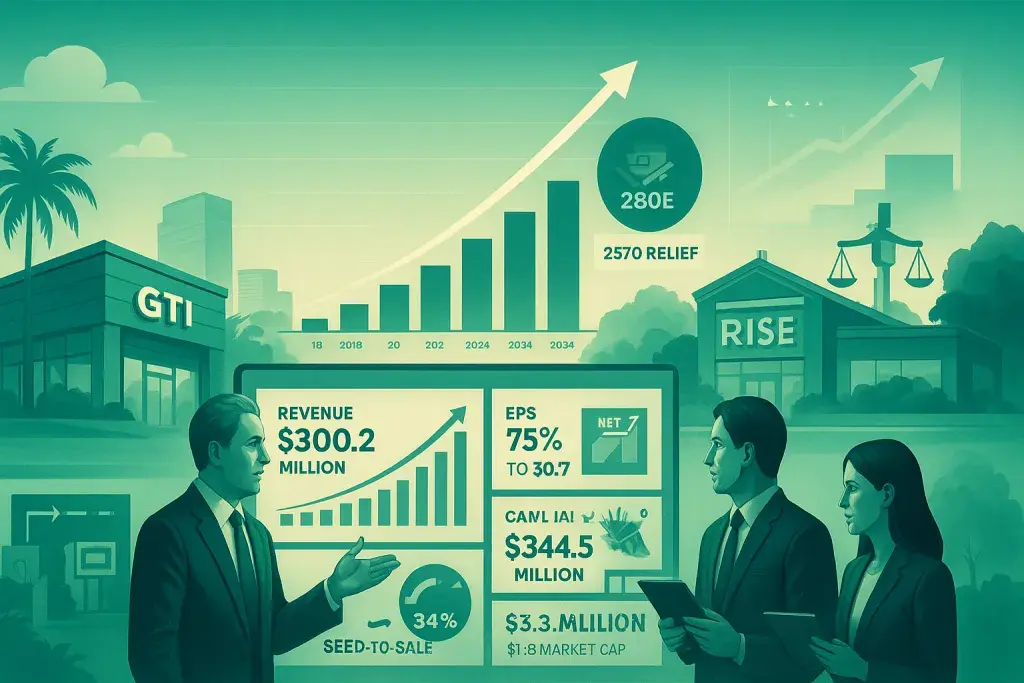
In its first-quarter results, Green Thumb reported revenue of $300.2 million, up 7.4% year over year, and earnings per share of $0.07, up 75% over the same period a year ago. The company held $344.5 million in cash, up from $289.9 million the prior period. For an industry where thin working capital has forced many operators into punishing debt arrangements, that cash position is operationally significant - it allows capital expenditures, license expansions, and opportunistic acquisitions without borrowing at rates that erode margin.
Green Thumb also repurchased $33.3 million in shares during the first quarter - a meaningful figure against a market capitalization of approximately $1.8 billion. Buybacks at that scale reduce the outstanding float, concentrate future earnings per share, and signal that leadership believes the stock is trading below intrinsic value. For institutional investors watching the cannabis sector become investable in a more conventional sense, that discipline matters.
The Adult-Use Question Still Hangs in the Air
The current rescheduling applies to medical-use operations. Adult-use recreational sales remain in a regulatory gray zone at the federal level - though an administrative hearing scheduled for June 29 could extend Schedule III status to adult-use cannabis as well. If that happens, the 280E relief expands to the full retail footprint of any multi-state operator with adult-use licenses.
Green Thumb operates 110 dispensaries across 14 states, with significant positions in markets on the edge of adult-use transition. It holds 22 dispensaries in Florida, 19 in Pennsylvania, and seven in Virginia - states where adult-use frameworks are either pending, recently enacted, or under active legislative consideration. When Minnesota launched its adult-use market in September, Green Thumb already had eight RISE dispensaries running, allowing those locations to absorb recreational demand without the ramp-up delays that hit less-prepared operators.
That footprint isn't accidental. Positioning dispensaries in advance of regulatory transitions - and having the capital to staff them, stock them, and comply with state-specific inventory tracking and packaging requirements - is exactly where balance sheet strength translates into market share. Most state-licensed adult-use markets require seed-to-sale tracking integration, compliant labeling, and updated POS configurations before a location can process recreational transactions. Operators without the infrastructure already in place lose weeks or months of revenue during transitions.
What the Broader Market Shift Means for Operators
The legal U.S. cannabis market was projected at $137.7 billion in 2026 and is expected to grow to $1.43 trillion by 2034, according to Fortune Business Insights - a compound annual growth rate of 34%. Those numbers reflect a market undergoing institutionalization, not just expansion. That means more standardized compliance frameworks, greater scrutiny of financial reporting, and increasing pressure on operators to run their businesses with the same discipline as any other regulated retail sector.
For dispensary operators below Green Thumb's scale, the rescheduling still matters - but the benefits require careful tax and legal counsel before anyone adjusts their filings. The IRS has not issued final guidance, and state-level tax treatment of cannabis income varies independently of federal scheduling. Operators should not assume that 280E relief is immediate, automatic, or uniform across all revenue categories without professional review.
What's striking here is how quickly the sector's investment story has shifted from regulatory risk to operational execution. For years, cannabis stocks moved on political headlines. That era appears to be ending. The companies that built real businesses - profitable, cash-generative, and positioned in licensed markets with clear growth trajectories - are now in a position to be evaluated like businesses. Green Thumb has spent years building for exactly this moment.