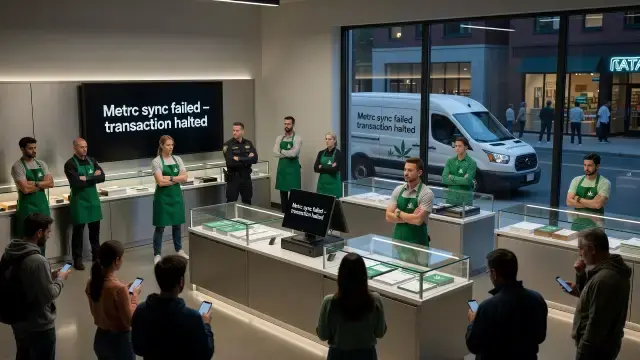
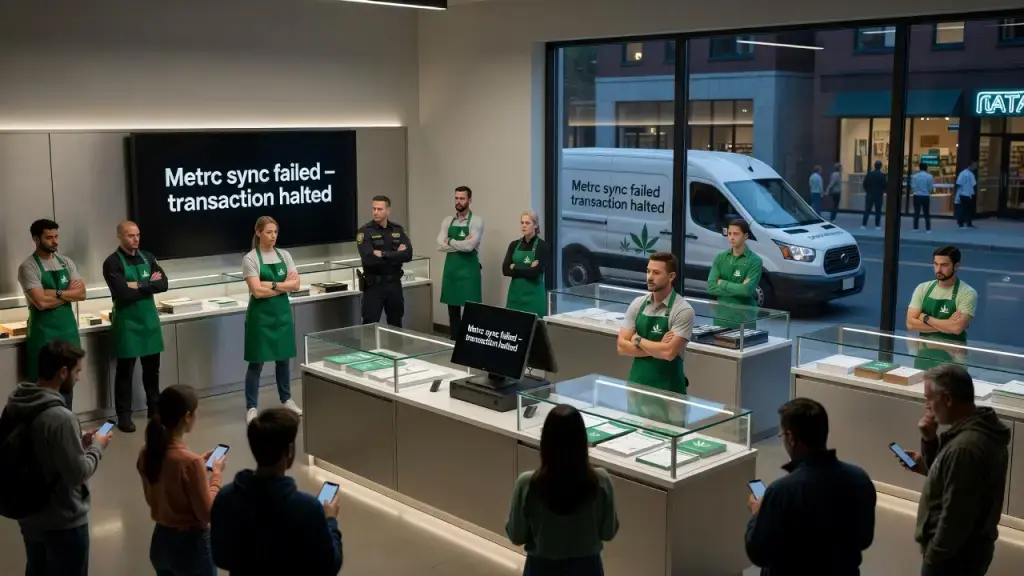
When a dispensary's point-of-sale system crashes, the register doesn't just go quiet - the whole operation does. Unlike a corner store that can fall back on a cash drawer and a paper ledger, licensed cannabis retailers are legally barred in nearly every state from improvising around a tech failure. No ID verification, no purchase-limit check, no real-time report to the state's seed-to-sale tracking system means no sale, full stop.
Why Cannabis Retail Can't Just "Go to Cash"
Here's the catch that separates cannabis from almost every other retail category: compliance isn't optional paperwork filed later, it's a real-time condition of doing business. Metrc and similar track-and-trace systems require that transactions sync as they happen, which means your POS terminal isn't just a sales tool - it's a regulatory reporting device. When it goes dark, so does your legal ability to transact. A liquor store can ring up a sale with a pen and a notepad if the system hiccups. A dispensary cannot, because state regulators built the compliance architecture directly into the software layer.
That dependency turns a routine IT failure into an operational shutdown. And the math is unforgiving: multiply your average hourly sales volume by the hours offline, and you get a direct, calculable loss. Run that outage on a Friday evening or during a holiday rush, and the number climbs fast.
The Costs That Keep Accumulating After the Screen Goes Black
Lost sales are the obvious hit, but they're not the only one. Budtenders, security staff, and inventory personnel remain on the clock even when there's nothing to sell. Labor costs don't pause just because the system did. Delivery operations face their own backlog - routing software, driver manifests, and ID verification all run through the same frozen infrastructure, which means delivery windows slip and compliance logs go unrecorded in real time.
Then there's the customer relationship, which is harder to rebuild than a server. Dispensary customers tend to have options nearby, and a storefront or app that can't process an order - even briefly - pushes them toward a competitor. Digital menus and loyalty platforms vanish right along with the POS connection, which is exactly what happened industry-wide when a widely used dispensary POS platform went down during a peak sales period. The lesson wasn't really about one vendor's outage; it was a reminder of how fragile the whole system is when software, compliance, and revenue are this tightly fused.
- Idle labor costs continue even when sales stop entirely
- Delivery manifests and driver ID checks halt mid-route
- Loyalty programs and online menus disappear with the outage
- Customer retention erodes quickly when competitors stay operational
Where Standard Tech Fixes Fall Short
Backup internet connections and hardware redundancy are worth having. They are not, however, a defense against a third-party server failure or a SaaS-side glitch that originates outside your building. That's a gap most operators don't notice until it's already cost them a weekend's revenue. Standard cyber liability insurance, for instance, is built to respond to security incidents - ransomware, hacking, data breaches - not to a vendor's accidental server crash. If your POS provider's infrastructure fails and no malicious actor is involved, a conventional cyber policy likely won't trigger at all.
To close that gap, operators need Contingent Business Interruption coverage or a Dependent System Failure endorsement layered onto their policy - protection specifically designed for financial loss caused by a third party's tech failure, not your own network being compromised.
What Software Vendors Should Be Carrying, Too
The exposure runs in both directions. POS platforms and menu-integration companies serving the cannabis sector face their own liability when an outage during a high-volume period causes dispensary clients to lose significant revenue. Angry operators, understandably, may pursue breach-of-contract claims. That's where Technology Errors & Omissions coverage matters: it's built to cover a software vendor's legal defense costs, settlements, and judgments when a product failure causes measurable financial harm to a client.
Nothing eliminates the possibility of a cannabis POS outage entirely - the dependency on real-time compliance reporting guarantees that risk stays baked into the business model. What operators and vendors can do is build a layered insurance program - cyber liability, contingent business interruption, and tech E&O working together - so that when the screens go black, the financial exposure doesn't have to.