
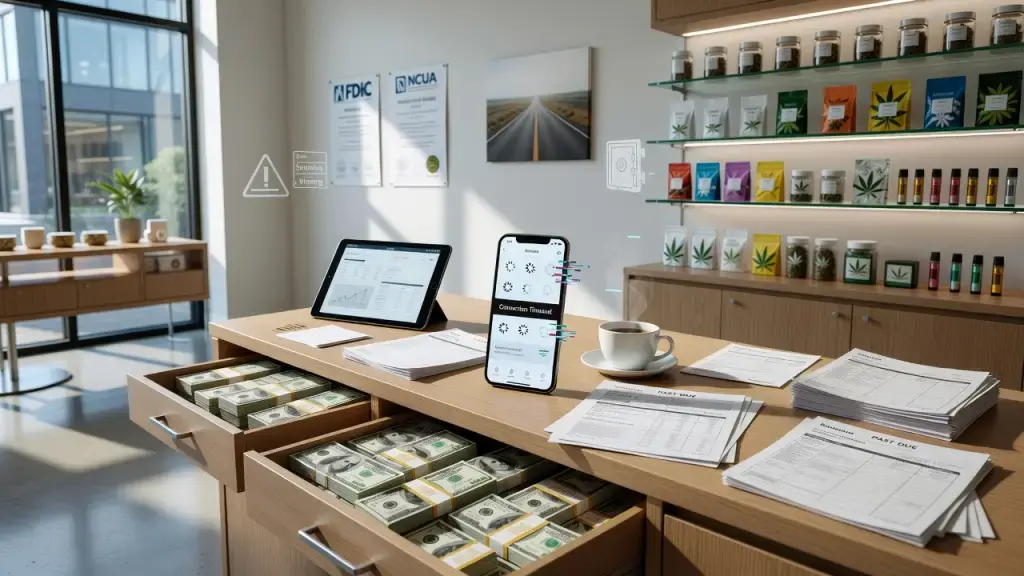
A dispensary operator checking a business banking app at 7 a.m. and finding it unresponsive faces a question that matters more in cannabis retail than almost any other industry: is this a glitch, or is this the bank itself going under? The distinction is not academic. Cannabis businesses already operate with thinner banking relationships than most retailers, and knowing the difference between an outage and a failure can determine how an operator handles payroll, vendor payments and cash deposits in the hours that follow.
Why banking access is a sharper issue for cannabis retailers
Most retail sectors can shrug off a banking app outage. Cannabis retail cannot, not entirely. Federal illegality still pushes many dispensaries toward a narrow pool of state-chartered banks and credit unions willing to take on cannabis accounts, often at higher fees and with tighter monitoring. When one of those institutions has a technical outage, an operator cannot simply open a new account down the street. Alternatives are limited, and that makes every banking disruption feel heavier than it would for a shoe store or a restaurant.
An outage, to be clear, is not a loss of funds. The bank's app, website or card network may stop working for hours, but the deposits sitting behind that interface are still recorded on the bank's books. A dispensary's end-of-day till reconciliation, its payroll run, its METRC-linked sales records - none of that changes because a login screen won't load. What changes is access. A manager who can't move money to cover a vendor invoice or an excise tax payment due that week has a real operational problem, even though the money itself hasn't disappeared.
A bank failure is a different animal - and insurance still applies
A bank failure is a solvency event, not a technical one. Regulators close a bank when it can no longer meet its obligations, and that closure is where deposit insurance becomes relevant. In the U.S., FDIC coverage protects deposits at member banks up to $250,000 per depositor, per bank, per ownership category. Credit unions carry equivalent protection through the National Credit Union Administration and its share insurance fund.
Here's the catch for cannabis operators specifically: many of the credit unions and community banks serving the industry are smaller institutions, and dispensary accounts often carry balances well above typical retail norms because of cash-heavy operations and limited access to lending. A multi-location operator sweeping daily cash deposits into a single account at one institution can blow past the $250,000 ownership-category limit without realizing it. Spreading deposits across ownership categories, or across more than one insured institution, is the standard way to keep a larger balance fully covered - the same approach any cash-intensive business should use, cannabis or not.
FDIC and NCUA coverage also does not extend to everything on a bank's product sheet. Investment accounts, merchant cash advances structured as outside financial products, and anything parked in a safe deposit box fall outside insured deposit coverage. For an industry still barred from many standard commercial banking products, operators should know precisely which accounts are insured deposits and which are something else entirely.
What operators should actually do when the app goes dark
In practice, the response to an outage and the response to a failure look almost nothing alike. An outage calls for patience, documentation and a fallback plan - keeping recent statements, tracking cash drawer totals, and confirming balances once systems return rather than assuming a screen error reflects a real shortfall. A failure calls for something more specific: confirming the institution's FDIC or NCUA membership status, understanding how business accounts are titled, and knowing that in most closures, insured deposits are either transferred automatically to an acquiring bank or paid out directly within a matter of business days.
Neither event is reason for panic on its own. But for a sector still navigating a scarcity of willing banking partners, the margin for confusion is smaller than it is elsewhere in retail. A dispensary that treats its banking relationship as fragile - checking insurance coverage before trouble hits, not after - is simply running the business the way any cash-sensitive, compliance-heavy operator should.