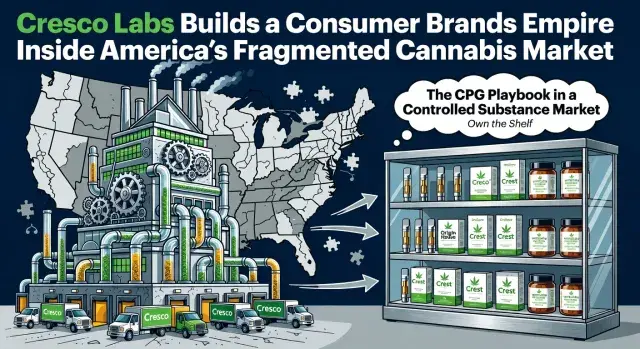
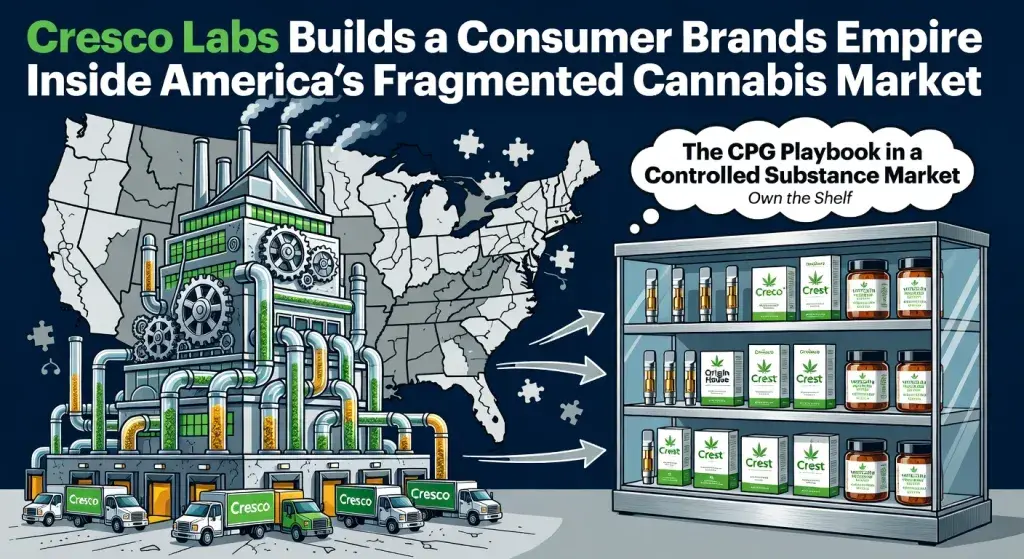
While much of the U.S. cannabis industry remains a patchwork of small operators hemmed in by state-by-state regulation, Cresco Labs has been assembling something more ambitious: a vertically integrated, multi-state operation designed not just to grow and sell cannabis, but to own the shelf. The Chicago-headquartered company controls cultivation, manufacturing, distribution, and retail - a full seed-to-sale chain - across multiple state markets. That structure isn't incidental. It's the whole thesis.
The CPG Playbook in a Controlled Substance Market
Here's what distinguishes Cresco Labs from the bulk of multi-state operators: it thinks like a consumer packaged goods company. That language - "house of brands," "consumer segments," "brand trust" - might sound like it was borrowed from Procter & Gamble's annual report. And that's precisely the point.
The company's brand portfolio is tiered to cover different consumer needs. Cresco, the flagship, targets experienced users. Remedi focuses on wellness-oriented products. And then there's Mindy's - an edibles line created by Mindy Segal, a pastry chef who holds a James Beard Award, which is roughly the culinary equivalent of a Pulitzer. That last brand is a telling move; it signals an attempt to pull cannabis edibles out of the dispensary ghetto and into the gourmet mainstream.
This CPG approach matters because cannabis, unlike alcohol or tobacco, doesn't yet have the benefit of federal legalization or interstate commerce. Every state is its own market with its own licensing, testing, and packaging rules. Building nationally recognized brands under those constraints is expensive and logistically punishing. Most operators don't bother. Cresco has bet heavily that brand equity will be the thing that compounds once - or if - federal barriers eventually fall.
Sunnyside and the Retail Side of the Equation
Vertical integration means nothing if you can't control the point of sale. Cresco's retail arm, Sunnyside, serves that function. Branded as a "wellness-focused" dispensary experience, it's designed to feel approachable - less head shop, more pharmacy-meets-boutique. The emphasis on education and trust isn't just marketing language; it reflects a real commercial problem. A significant portion of potential cannabis consumers are curious but intimidated. They don't know dosing. They don't know formats. They don't know what questions to ask.
Sunnyside's design tries to lower that threshold. Whether it succeeds store by store is an empirical question, but the strategic logic is sound: capture new consumers early, build loyalty, and funnel them into your own branded products. Owning both the shelf and the store - that's where the margin lives.
Social Equity as Strategy and Obligation
Cannabis legalization carries a particular moral weight. Decades of criminalization fell disproportionately on Black and Latino communities, and the industry's rapid corporatization has raised uncomfortable questions about who actually benefits from legal markets. Cresco Labs has responded with SEED - Social Equity and Educational Development - which the company describes as the industry's first national comprehensive initiative of its kind.
SEED is designed to provide skills training, education, and business ownership pathways for people from communities historically harmed by cannabis prohibition. Fair enough - but the initiative also serves a harder-nosed purpose. In many states, social equity commitments are a precondition for licensing. Companies that build credible equity programs position themselves favorably with regulators and municipal governments. This doesn't make the effort cynical. It does make it dual-purpose, which is worth acknowledging plainly.
What Lies Ahead
Cresco Labs sits at an interesting inflection point. The U.S. cannabis market is maturing, consolidating, and - in some states - contracting under price compression. Multi-state operators with high debt loads and aggressive expansion timelines have been punished. The companies best positioned for the next phase will be those with strong brands, efficient supply chains, and enough geographic breadth to absorb regional volatility.
Cresco has built toward all three. The open question is timing. Federal rescheduling or descheduling of cannabis would unlock banking access, interstate commerce, and capital markets - conditions under which a CPG-oriented operator could scale rapidly. Until then, the company operates in a strange twilight: building national infrastructure inside a market that doesn't yet legally function as one. It's an expensive bet on a future that keeps arriving more slowly than expected.