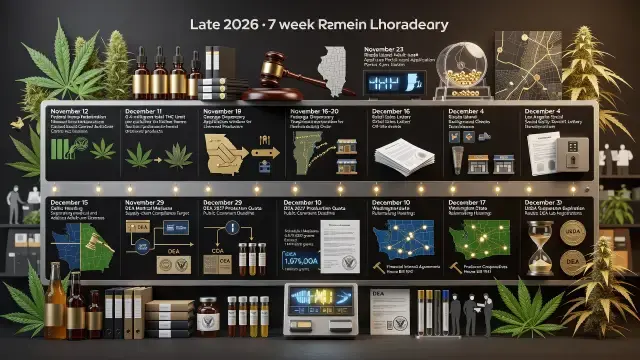
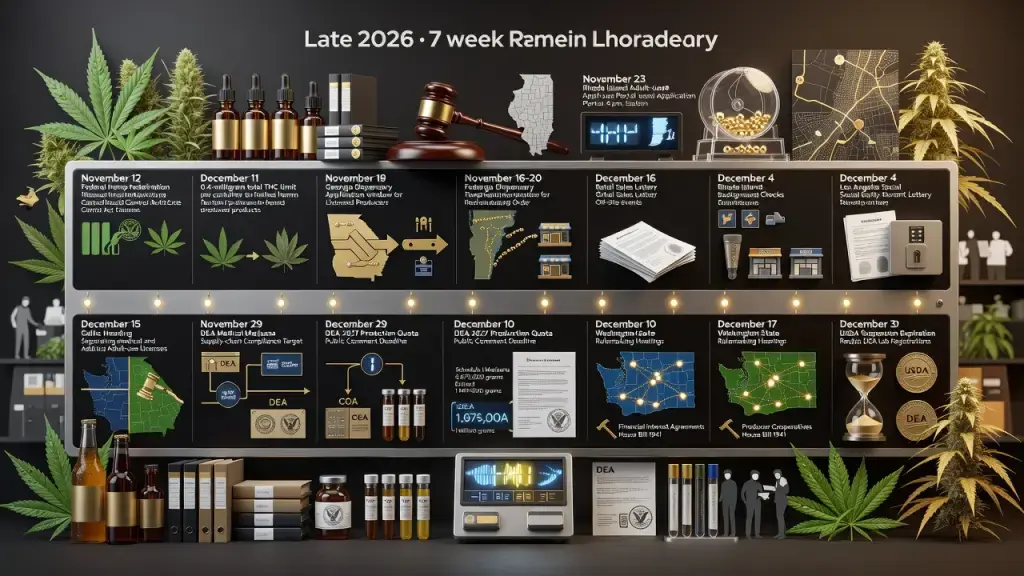
Seven weeks remain in 2026, and the cannabis and hemp industries are staring down a compressed stretch of federal deadlines, court dates and state licensing windows that could reshape how products move through the supply chain heading into next year. Some of these dates carry immediate compliance consequences. Others are procedural, but the kind that quietly determines which businesses get a license and which get left waiting another cycle.
Federal Hemp Rules Tighten in Two Stages
The most consequential shift is happening in pieces. On November 12, a narrower provision of the federal hemp redefinition takes effect, cutting off products containing cannabinoids that cannot occur naturally in the cannabis plant. That's the piece Congress didn't delay. The bigger restriction - a 0.4-milligram total THC limit per container for finished hemp-derived cannabinoid products - arrives December 11, unless lawmakers intervene before then. In practice, though, waiting on Congress is not a compliance strategy. Brands selling hemp-derived beverages, tinctures and edibles need to audit formulations now, because products that clear shelves today may not qualify as hemp at all come mid-December. Missouri's own Intoxicating Cannabinoid Control Act adds a parallel state-level restriction starting November 12, and Illinois is fighting its version in federal court, with a hearing scheduled for November 19 over a temporary restraining order. The outcome there could determine whether hemp retailers outside licensed dispensaries stay open past that date.
Separately, hemp testing infrastructure faces its own cliff. The USDA's suspension of DEA lab registration requirements expires December 31. Unless extended again, registered hemp labs will need DEA registration starting January 1 - a logistical scramble for growers who depend on adequate testing capacity to get compliant COAs before product ships.
Licensing Windows and Lotteries Operators Should Track
Several states are opening or closing retail opportunities in rapid succession. Rhode Island closes its adult-use retail application portal November 23 at 4 p.m. Eastern - zoning approval included, no exceptions. Los Angeles holds its social equity storefront lottery December 4, with a registration webinar November 19 for applicants who want to understand the mechanics beforehand. Georgia opens a short, five-day dispensary application window from November 16 to 20, limited to existing licensed producers as the state's medical registry nears 65,000 patients.
- Vermont runs a lottery December 16 for a new pilot allowing retail sales at approved off-site events, with no on-site consumption permitted.
- Rhode Island requires background checks for majority license owners by December 4.
- California holds a public hearing December 15 on separating combined medical and adult-use licenses - a move tied directly to federal rescheduling and medical marijuana's path toward DEA registration.
Supply Chain and Federal Registration Pressure Builds
The DEA's November 29 target for medical marijuana supply-chain compliance deserves close attention from multi-state operators. Businesses with timely federal registration applications are generally expected to source Schedule III medical marijuana only from other timely applicants or DEA-registered entities. The guidance is nonbinding, but it signals where enforcement expectations are headed. Operators who haven't verified trading partners should not assume existing inventory arrangements carry over cleanly into the new framework.
Public comment periods matter here too. The DEA's 2027 production quota proposal - holding Schedule I marijuana at 6,675,000 grams and extract at 1 million grams - closes for comment December 10, with Schedule III quotas still being developed separately. Washington state is running its own parallel rulemaking, with hearings December 10 on financial interest agreements and December 17 on producer cooperatives under House Bill 1941.
What's Still Unresolved
No date yet exists for Chief Administrative Law Judge Derek Julius's recommendation on marijuana rescheduling, though briefing closed November 5. Congress could still move on SAFE Banking or hemp regulation before year-end, and several states - Wisconsin, Pennsylvania, Iowa, Kansas, New Hampshire among them - may signal 2027 legalization intentions before legislatures reconvene in January. None of this is guaranteed. But for compliance teams, wholesalers and retail operators, the next seven weeks are not a quiet stretch before the holidays. They're a compliance calendar that needs a checklist, not a guess.