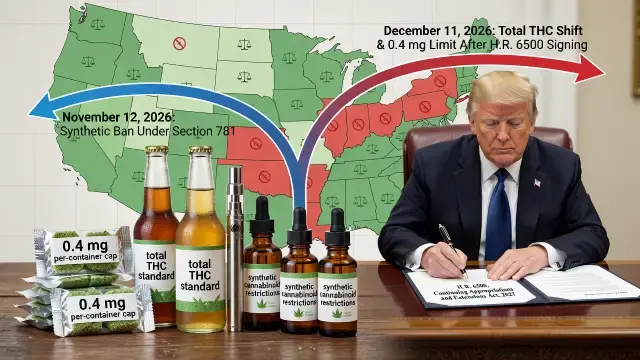
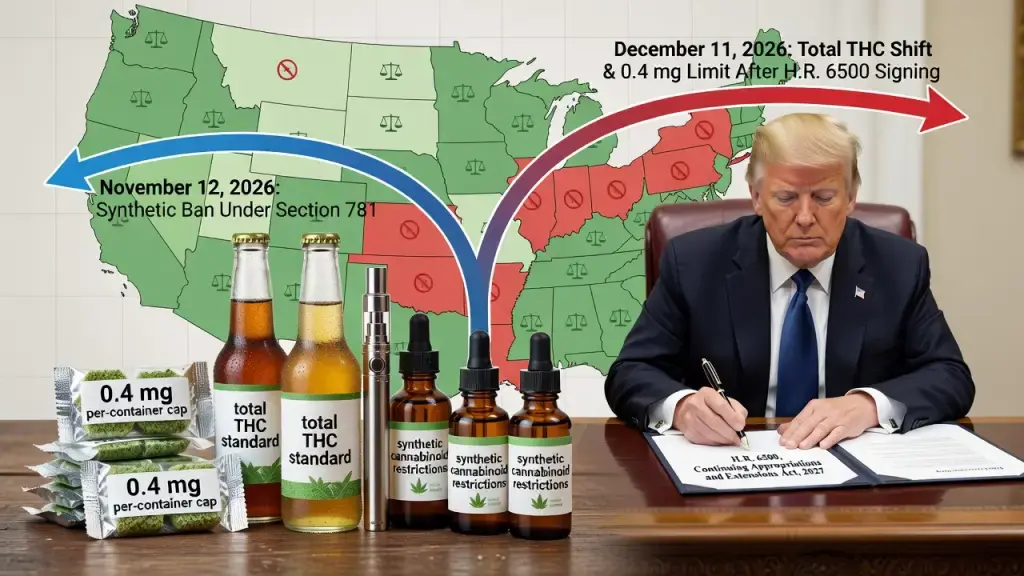
The federal hemp industry just got a reprieve, but not a full one. President Trump's September 2 signing of H.R. 6500, the Continuing Appropriations and Extensions Act, 2027, splits what was supposed to be a single compliance deadline into two. Operators now face a staggered rollout: synthetic cannabinoid restrictions still land November 12, 2026, while the new total THC standard and the 0.4 mg per-container cap get pushed to December 11, 2026. For an industry that has spent the better part of a year bracing for one cliff edge, this is now two.
Why the Split Matters More Than It Looks
On paper, a 29-day delay doesn't sound like much. In practice, though, it forces hemp brands to comply with two different rule sets on two different timelines, using two different compliance checklists. The synthetic cannabinoid ban under Section 781 targets cannabinoids that can't occur naturally in a Cannabis sativa plant - think lab-modified compounds rather than naturally derived ones. That part of the law wasn't delayed at all. Meanwhile, the provision that actually reshapes product formulation - the shift from a delta-9 THC threshold to a total THC standard, plus the 0.4 mg per-container ceiling - got the extra month. Brands now need compliant testing and COA protocols ready for one deadline while still finalizing reformulation work for the other. That's a supply chain headache, not a technicality.
States Are Not Waiting on Washington
Here's the catch for multi-state operators: state hemp programs are not moving in lockstep with the federal calendar, and some never intended to. Minnesota's Office of Cannabis Management has said it will keep regulating hemp-derived products under its own statutory framework regardless of what happens federally - though products that fall outside the new federal definition would lose federal "hemp" status, cutting off interstate commerce for those SKUs. Rhode Island is doing the opposite: adopting the federal definition outright on December 11, 2026, with no transition period and no pathway to shift noncompliant inventory into the state's regulated cannabis market.
Other states locked in the 0.4 mg per-container standard on their own fixed dates, independent of federal delays. Ohio's cap already took effect March 20, 2026. New Jersey implemented its version January 13, 2026, for most products, with beverages carved out through November 13, 2026 - though pending legislation could stretch that beverage window to match the federal date. Illinois set a fixed alignment date of November 12, 2026. Missouri tied its law directly to the federal effective date, so it moves whenever Washington moves. For wholesalers and brands selling across state lines, that means tracking a patchwork of compliance dates rather than a single national one.
A Narrower Window for an Already Constrained Program
The CMS Innovation Center's Substance Access Beneficiary Engagement Incentive program, launched April 1, 2026, lets select physicians in Accountable Care Organizations offer hemp cannabinoid therapies to qualifying patients using what it calls "Eligible Hemp Products." Those products already carry tight limits - no more than 0.3% delta-9 THC by dry weight, a 3 mg per-serving cap on total tetrahydrocannabinols for orally administered products, no synthetic cannabinoids, no inhalables. Layer the new 0.4 mg per-container federal cap on top of that, and the pool of compliant products available to the program shrinks further. That has real consequences for a program meant to generate data that could inform federal cannabis policy; a thinner product set means thinner evidence.
What Operators Should Be Doing Right Now
With lawmakers adjourned for campaigning and a lame-duck session the only realistic venue for further delay or a regulatory framework, operators shouldn't bank on another extension. Bills like Rep. Van Duyne's Beverage Regulatory Parity Act and Rep. Barr's Lawful Hemp Protection Act remain pending in committee, and any viable federal fix will likely need to include potency limits, age restrictions, manufacturing and testing requirements, and packaging rules to address lawmakers' concerns about youth access. Realistic paths forward for operators fall into a few categories:
- Reformulate products to the 0.4 mg per-container cap and document the compliance transition, including updated COA protocols.
- Pivot toward licensed adult-use or medical cannabis channels in states with workable licensing timelines, or operate intrastate in states like Minnesota that maintain independent hemp frameworks.
- Wind down in an orderly fashion - clearing inventory, exiting leases and co-manufacturing agreements, and selling off brand IP and equipment ahead of the applicable deadline.
Whichever path a brand chooses, the clock is now running on two separate dates instead of one, and the gap between them is where a lot of compliance risk will concentrate.