Tilray Brands Inc. is back in the cannabis stocks conversation, and the reason is specific rather than cosmetic: fresh coverage ties the company's cannabis operations to its broader consumer-product business, giving the market something concrete to react to. That matters for anyone tracking the sector on the S&P/TSX Composite Index, where cannabis names tend to move together even when their underlying businesses don't. The question worth asking isn't just what this means for Tilray. It's what it says about how the whole group is being priced right now.
Why This Update, Why Now
The timing here isn't arbitrary. Public filings and market reporting establish the facts; the harder part is explaining why they land now rather than six months ago. For Tilray, the hook is the overlap between its cannabis segment and its non-cannabis consumer lines - a structure that makes the company harder to categorize than a pure-play cultivator, and arguably more interesting to analysts trying to model where margin actually comes from. That overlap is the specific detail that justifies renewed attention, not a vague sector mood.
A sector read-through approach asks a narrower question: what new information does this update actually put on the table? That keeps the story anchored to things that can be checked against company disclosures, rather than inflated into a broader claim the evidence doesn't support.
Where Tilray Sits Against Sector Pressure
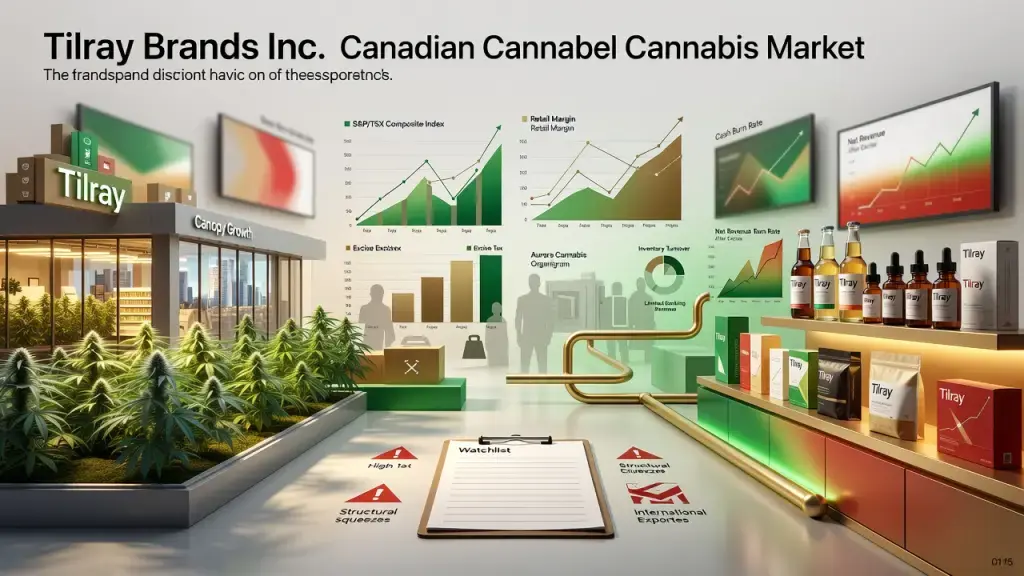
Canadian cannabis retail and wholesale operators are still working through the same structural squeeze: thin retail margins, excise tax that eats into net revenue before a company even gets to gross profit, provincial distribution bottlenecks, and medical export demand that has grown more slowly than early projections suggested. Which of those pressures hits hardest depends on the business model - a vertically integrated operator with its own retail footprint feels pricing compression differently than a wholesale-only brand competing on a crowded menu.
The sector overall has shifted from an expansion mindset to one built around cost discipline and cash preservation. Companies that once competed on store count or cultivation capacity are now judged on gross margin stability, inventory turnover and how much cash they're burning per quarter. Tilray's consumer-product exposure gives it a different cost and revenue mix than a company such as Canopy Growth, Aurora or Organigram, which is exactly why peer comparisons need to be handled carefully rather than treated as interchangeable.
What Actually Confirms the Story
Here's the catch with any company-level cannabis headline: attention fades fast unless something measurable follows it. A press mention alone doesn't tell a reader much. What does tell the story is net revenue after excise, gross margin trend, cash burn rate and inventory levels in the next reporting cycle. Those are the line items that confirm - or quietly undercut - whatever narrative today's coverage is building.
In practice, that means treating this update as a starting point for a watchlist, not a conclusion. Readers tracking Tilray alongside other Canadian names can use sector coverage to compare it against peers, but the comparison only holds up if each company is assessed on its own balance sheet and operating model rather than lumped under a single ticker-tape label.
The Limits of One Company Update
None of this changes the structural issues facing cannabis stocks as a group. Limited banking access, high effective tax burdens tied to federal treatment in comparable U.S. markets, retail price compression, and slow-moving international medical channels remain live constraints regardless of what one company reports in a given quarter. A single Tilray update is a data point, not a sector turning point.
Sector read-through coverage is most useful when it says plainly what it doesn't know yet. Where Tilray hasn't published guidance or operating detail on a given question, the honest move is to flag that gap and wait for the next scheduled disclosure - not fill it in with assumptions dressed up as analysis.